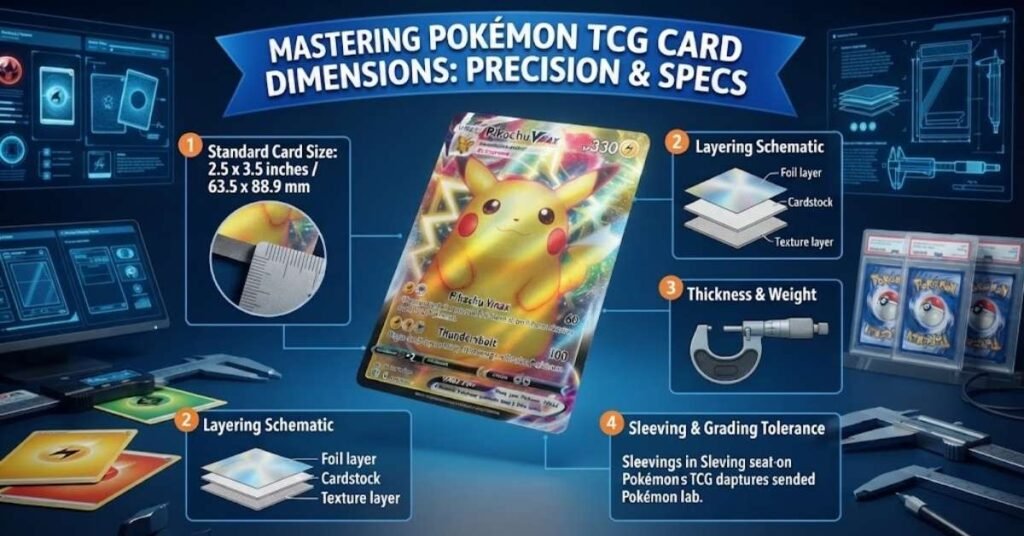

A standard Pokemon card measures 2.5 x 3.5 inches, or 63.5 x 88.9 mm if you’re the metric type. That’s the short answer. But if you collect, trade, grade, or just want your cards to survive your little cousin’s sticky fingers, the details matter a lot more than that one line suggests. This guide breaks down every Pokemon card measurement you’ll ever need, from thickness and weight to sleeve sizing and storage.
Pokemon Card Dimensions at a Glance
Here’s the deal before we go deep. Every official Pokemon TCG card, no matter the set or rarity, sticks to the same standard trading card footprint. That consistency is why sleeves, binders, and top loaders made for one trading card game often fit another without a fuss.
You’ll see slight rounding depending on the source. Some list width as 2.5 inches, others say 2.48. Neither one is wrong exactly. Manufacturing tolerances cause tiny shifts, but the ballpark stays locked at 2.5 x 3.5 inches.
Quick Facts
- Width: 2.5 inches (63.5 mm)
- Height: 3.5 inches (88.9 mm)
- Card thickness: roughly 0.3 mm, often labeled 35pt
- Weight: about 1.8 grams per card
- Aspect ratio: close to 5:7
- Corner style: rounded, around 0.125 inch radius
Standard Pokémon Card Size
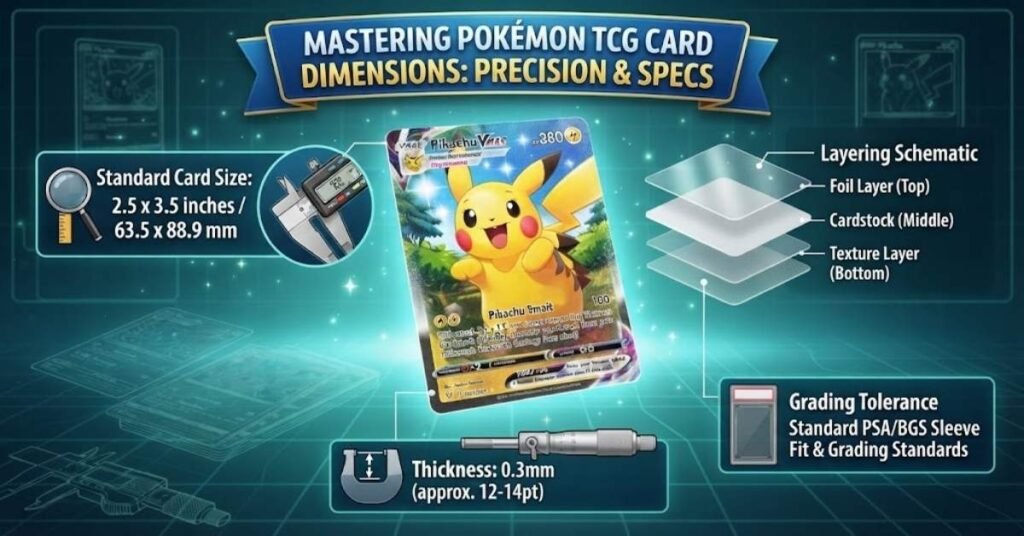
Let’s zoom in on the number everyone actually searches for. A standard Pokemon card is 2.5 inches wide and 3.5 inches tall. In centimeters, that’s 6.35 x 8.89 cm. This has held true since the game launched back in 1996, and it isn’t changing anytime soon.
Why does this matter beyond trivia? Because tournament rules require tournament legal cards to sit within this exact standard card size. Anything oversized gets you side-eyed at a locals event, and rightly so.
The thickness sits around 0.3 mm, sometimes described as 35pt in collector shorthand. Holo and reverse holo prints can creep up toward 55pt because of the extra foil layer. That thickness difference is subtle to the eye but noticeable once you stack a deck and feel the bulge.
Size Comparison: Pokémon Card vs Credit Card
Grab a credit card from your wallet for a second. A credit card measures 3.37 x 2.125 inches, so it’s actually a bit wider and noticeably shorter than a Pokemon card.
Flip a Pokemon card sideways and the two aren’t far off in overall footprint, but the proportions differ enough that credit card sleeves will never work as a substitute. This comparison helps people visualize scale without pulling out a ruler, which honestly, most of us never do until we’re arguing about it online.
Pokemon Card Size Conversion Chart
Numbers hit differently depending on the unit, so here’s everything side by side.
| Measurement | Inches | Millimeters | Centimeters |
|---|---|---|---|
| Width | 2.5 in | 63.5 mm | 6.35 cm |
| Height | 3.5 in | 88.9 mm | 8.89 cm |
| Thickness | ~0.012 in | ~0.3 mm | ~0.03 cm |
| Corner radius | ~0.125 in | ~3.2 mm | ~0.32 cm |
Keep this size conversion chart bookmarked. It comes in handy when you’re ordering sleeves or a card protector from an overseas seller who only lists metric measurements.
Pokemon Card Size Comparison
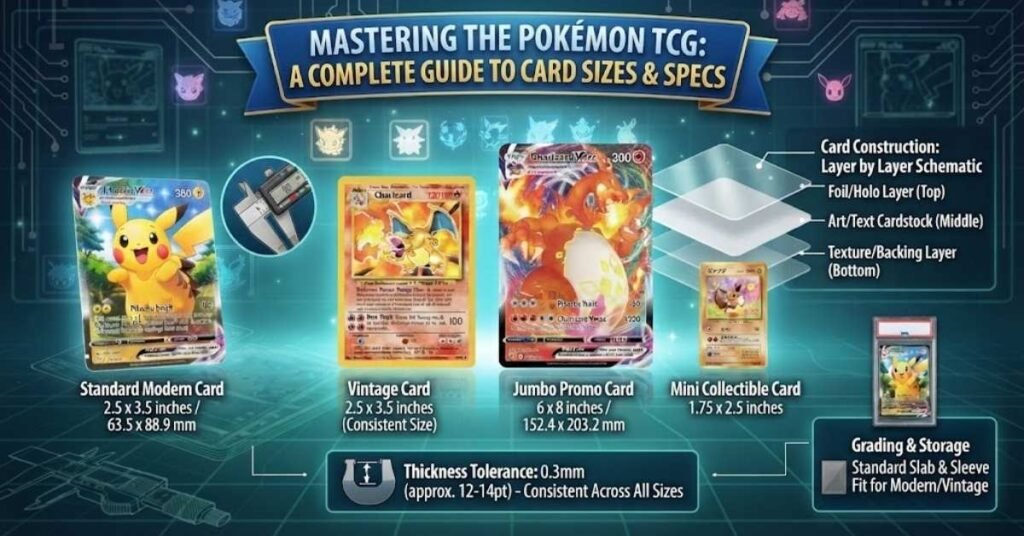
How does a Pokemon card stack up against other collectible card games? Magic: The Gathering cards share the exact same 2.5 x 3.5 inch footprint, so MTG cards and Pokemon cards are fully interchangeable in sleeves and binders.
Yu-Gi-Oh cards run smaller at roughly 2.3 x 3.3 inches, close to what’s called “small size” or Japanese standard sizing. Sports cards, including baseball cards and basketball cards, technically match the same 2.5 x 3.5 inch dimensions too, though the cardstock feels different in your hand.
Sleeves and Protectors for Pokemon Cards
If you’ve ever bent a first edition card by accident, you already know why card sleeves exist. Standard card sleeves run around 66 x 91 mm, giving your card just enough wiggle room to slide in without tearing at the corners.
Penny sleeves are the thinnest option, usually measuring close to 64 x 89 mm, and they’re meant purely for basic dust protection, nothing fancier. For collectors chasing that snug, no-shift feel, perfect-fit sleeves hug the card almost exactly, which is why many people use them underneath a second, looser sleeve. That combo is called double sleeving, and it’s the gold standard for protecting anything valuable.
Special Pokemon Card Sizes and Variations
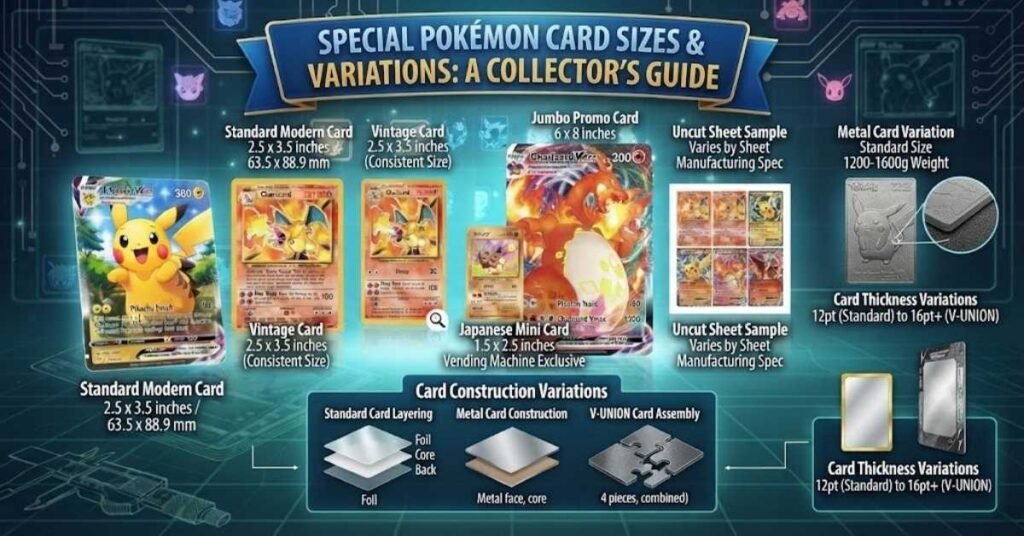
Not every Pokemon card plays by the standard rulebook. Jumbo Pokemon cards, sometimes called oversized Pokemon cards, can measure anywhere from 5.8 x 8.3 inches up to larger promotional formats, and they’re strictly display pieces, never tournament legal.
Promo cards and mini cards occasionally show up in novelty sizes tied to specific box sets or events. There’s also a real, if small, size gap between Japanese Pokemon cards and English Pokemon cards. Japanese prints measure closer to 59 x 86 mm, a few millimeters trimmer on both sides.
That gap sounds tiny, but sleeve shoppers notice it fast. A sleeve built for English Pokemon cards can feel loose around a Japanese Pokemon card, so always check regional printing before ordering in bulk.
How to Choose the Right Sleeve Size
Picking a sleeve isn’t just grabbing the first pack you see at the store. Start with your goal. If you’re playing in tournaments, a standard card sleeve around 66 x 91 mm is the safe, official formats approved choice.
If you’re storing a card you plan to send for card grading, go with a perfect-fit sleeve first, then a slightly bigger outer sleeve on top. This double sleeving method protects against scratch protection issues and keeps the corners crisp, which graders absolutely notice.
For binder storage, match your sleeves to your binder pockets. Most 9-pocket binder pages are built around that same standard card size, so there’s rarely a mismatch if you stick with mainstream brands.
How to Measure a Pokemon Card
Want to check a card yourself instead of trusting a listing? It’s easier than it sounds.
- Lay the card flat on a flat surface, no curves or bends
- Use a ruler or, better yet, a digital caliper for an accurate measurement
- Measure width first, then height, then thickness along one edge
- Compare your numbers against the 2.5 x 3.5 inch standard
Small variations of a millimeter or two usually come down to manufacturing differences, not a fake card. But if a card measures noticeably off, like half an inch smaller, that’s worth a second look before you trust its authenticity.
Common Mistakes When Buying Pokemon Card Sleeves
Even experienced collectors mess this up more often than you’d think.
- Buying penny sleeves and expecting premium sleeve level protection
- Ignoring the difference between inner sleeve and outer sleeve roles
- Grabbing sleeves sized for Japanese Pokemon cards when you collect English Pokemon cards
- Skipping a top loader for cards headed into long term storage
- Assuming every “trading card sleeve” fits every trading card game equally
That last one trips people up constantly. A sleeve labeled generic “trading card sleeves” might actually be cut for Magic: The Gathering or sports cards, and while the standard card dimensions overlap, the fit can still feel slightly off.
Tips for Storing Pokemon Cards
Storage is where most collections quietly get ruined, usually through neglect rather than accidents.
Keep cards away from direct sunlight and humidity. Both moisture protection and UV protection matter more than people realize, since faded or warped cards lose value fast. A proper deck box or card binder works well for everyday collections, while a magnetic case or graded slab suits your prized pulls.
For anything genuinely valuable, consider a dedicated storage solution like a fireproof box. It sounds dramatic until the one time it isn’t, and by then it’s too late to wish you’d bothered.
Why Pokemon Card Dimensions Matter for Grading and Value
Here’s a piece most guides skip entirely. Card grading services like PSA actually factor in physical condition tied directly to standard card specifications. A warped or trimmed card, even by a millimeter, can tank a grade instantly.
This is exactly why high-grade cards command such steep prices. Take the 1999 Pikachu Illustrator, long considered the crown jewel of the hobby. Logan Paul famously paid $5.275 million for a PSA 10 copy back in 2021, and in February 2026 that very card resold at auction for a staggering $16.492 million, making it the most expensive trading card ever sold. Perfect corners and flawless surface, tied straight back to those precise standard dimensions, are a huge reason it commanded that price.
Frequently Asked Questions
Are all Pokémon cards the same size?
Yes, virtually all official cards share the same 2.5 x 3.5 inch footprint, aside from clearly labeled jumbo or promotional exceptions.
What size binder pockets fit Pokémon cards?
Standard 9-pocket binder pages built for standard-size trading cards fit Pokemon cards without any adjustment needed.
Can Pokémon cards fit baseball card sleeves?
Yes, since baseball cards share the same 2.5 x 3.5 inch standard, most sleeves are fully interchangeable.
What size top loader should I use for Pokémon cards?
A 3 x 4 inch top loader, often called a 35pt top loader, fits standard cards with comfortable clearance.
Can Pokémon cards fit Magic: The Gathering sleeves?
Absolutely. MTG cards and Pokemon cards share identical standard dimensions, so sleeves cross over easily.
Why are Pokémon cards the same size worldwide?
It comes down to a global manufacturing standard that keeps compatibility consistent for official gameplay and accessories everywhere.
What are the dimensions of a Pokémon card?
A standard card measures 2.5 x 3.5 inches, or 63.5 x 88.9 mm in metric terms.
What is the size of a standard TCG card?
Most Trading card game (TCG) titles, Pokemon included, follow that same 2.5 x 3.5 inch benchmark.
Are Pokemon cards 35pt or 55pt?
Standard cards sit near 35pt. Foil or holo cards run thicker, closer to 55pt, due to the extra layer.
What is the $5.275 million Pokémon card?
That’s the 1999 Pikachu Illustrator, a PSA 10 graded card Logan Paul bought in 2021, which later resold for over $16 million in 2026.
What Pokémon card costs $1,000,000?
Several high-grade, low population cards from the 1999 Base Set have crossed the million dollar mark at auction over the years.
Why is 1999 Charizard so expensive?
The 1999 Base Set Shadowless Charizard combines nostalgia, scarcity, and iconic artwork, driving demand well above most rare Pokemon cards.
Will 3×4 sleeves fit Pokemon cards?
Yes, 3 x 4 inch sleeves and top loaders are a standard, reliable fit for regular sized cards.
How many cm is a Pokémon card?
A standard card measures 6.35 x 8.89 cm.
What is the height and width of a card?
Height sits at 3.5 inches (88.9 mm), while width comes in at 2.5 inches (63.5 mm).
Conclusion
At the end of the day, Pokemon card dimensions aren’t just numbers for spec sheets. They decide what sleeve you buy, whether your card survives grading, and even how collectors judge authenticity at a glance.
Stick to the 2.5 x 3.5 inch standard, measure carefully when something feels off, and invest in proper card protection early. Your future self, and your wallet, will thank you the day one of these cards turns out to be worth a lot more than you paid for it.