

So you hit 7,000 steps today. Nice work. But what does that actually mean in miles?
Here’s the short answer. 7,000 steps equal roughly 3 to 3.5 miles if you’re walking. Jog it out and you’ll cover close to 4.3 miles. Run it, and you’re looking at nearly 6 miles. The number changes because your stride length changes with every activity type.
Your height, your walking speed, and even the terrain under your feet all play a part too. Let’s break down exactly what 7K steps means for you, whether you’re strolling, jogging, or pushing a full run.
7000 Steps to Miles Conversion
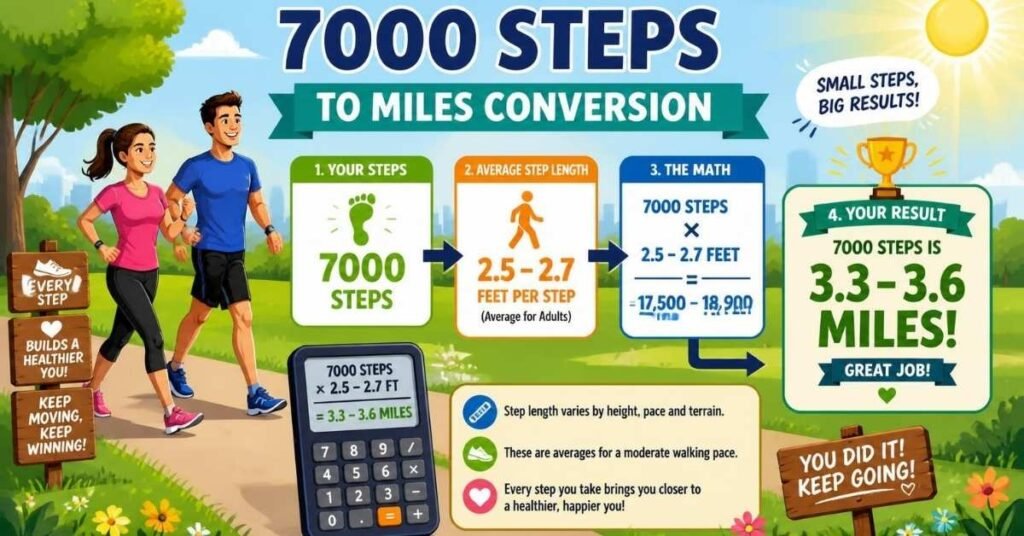
The math behind step-to-mile conversion isn’t complicated once you know the formula. You take your total steps, multiply by your stride length in feet, then divide by 5,280 feet in a mile.
For an average adult with a stride of about 2.5 feet, 7,000 steps works out to roughly 3.3 miles. That’s the number most fitness tracker apps use as a default before you customize your profile.
But stride length isn’t the same for everyone. A taller person covers more ground per step. A shorter person needs more steps to hit the same distance traveled. That’s why your own number might land a bit above or below 3.3 miles.
How Many Kilometers Is 7,000 Steps?
If kilometers are more your thing, here’s the deal. 7,000 steps at an average walking stride comes out to about 5.3 kilometers.
Jogging that same step count brings you closer to 6.9 kilometers, since your stride opens up and covers more distance per step. Running pushes it further still, landing somewhere near 9.6 kilometers for most adults.
These numbers shift slightly based on your height and your natural step length. Someone with a longer running stride will cover more kilometers per hour than someone with a shorter one, even at the same step count.
How Walking, Jogging, and Running Change Your Step Length
Here’s something a lot of people miss. Your step length isn’t fixed. It stretches and shrinks depending on your pace.
When you walk, your feet stay closer together and one foot is usually touching the ground. This keeps your stride short and controlled, which is great for injury prevention but means you need more steps to cover a mile.
Jogging changes the game. Your stride extension increases, and there’s a brief moment where both feet leave the ground, called the flight phase. This single change is why jogging covers more distance per step than walking does.
Running takes this even further. Your ground contact time drops, your foot movement becomes more explosive, and your body movement shifts to cover serious ground with every stride. That’s why the same 7,000 steps turns into almost double the distance when you switch from walking to running.
How Long Does It Take to Walk 7,000 Steps?
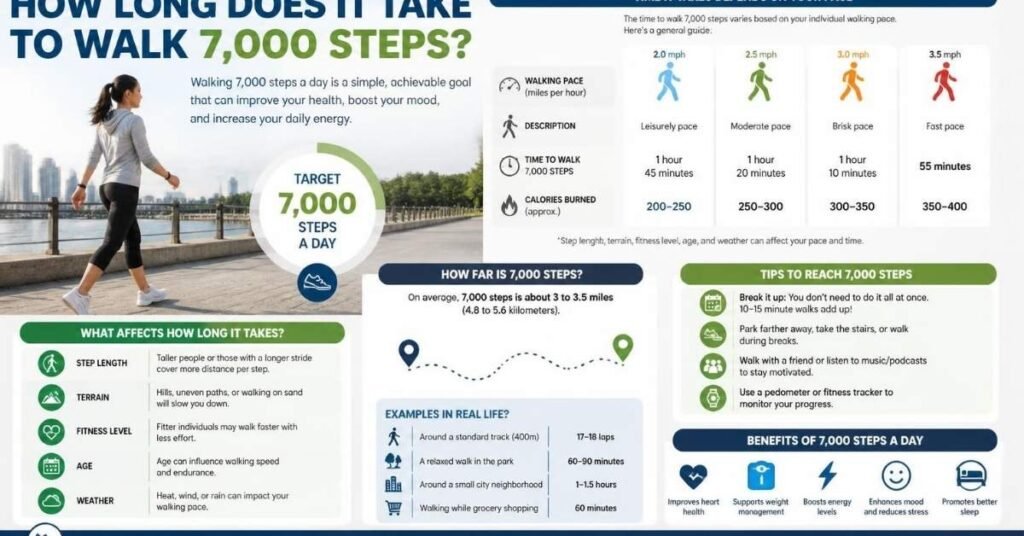
Most people walk at a moderate pace of around 100 to 125 steps per minute. At that rate, 7,000 steps takes somewhere between 56 and 70 minutes.
If you’re doing brisk walking at a faster clip, closer to 3 to 4 mph, you can knock that time down to around 60 minutes flat. Slow walking, on the other hand, might stretch things out closer to 75 minutes.
Your actual time depends on your walking speed, your fitness level, and even the terrain you’re covering. A flat sidewalk moves faster than a hilly trail, and that difference adds up over 7,000 steps.
Converting Steps to Miles
Now let’s get specific. Here’s how 7,000 steps breaks down by activity type and gender, using average stride length figures for each group.
Walking – Men (Average stride: 2.5 ft)
Men walking at a typical stride length of 2.5 feet will cover about 3.31 miles in 7,000 steps. That’s using the standard formula: steps multiplied by stride length, divided by 5,280 feet in a mile.
This number assumes a normal walking pace, nothing rushed and nothing dragging. Your actual male walking distance may vary slightly based on your height and your natural gait.
For most men between 5’8″ and 6’0″, this 3.3 mile mark is a solid, reliable estimate for daily step count planning.
Walking – Women (Average stride: 2.2 ft)
Women, with a typical stride of 2.2 feet, cover roughly 2.92 miles across 7,000 steps. That’s a bit shorter than the men’s estimate, purely because of the shorter average female walking distance per step.
This doesn’t mean women walk slower or less efficiently. It’s simply a matter of average body proportions and leg length across the population.
If you’re a taller woman, your actual mileage will likely land closer to the 3.1 or 3.2 mile range instead.
Jogging – Men (Average stride: 3.25 ft)
Switch to jogging, and that same 7,000 steps stretches to about 4.31 miles. The longer jogging stride eats up more ground per step compared to walking.
This is a great number to know if you’re chasing fitness goals tied to distance rather than just step count. Jogging 7,000 steps gets you nearly a mile and a half further than walking the same count.
Keep your jogging pace in the 5 to 6 mph range for this estimate to hold true. Faster or slower paces will shift your stride slightly.
Running – Men (Average stride: 4.5 ft)
Running is where the numbers really jump. At a stride of 4.5 feet, 7,000 steps covers close to 5.97 miles, essentially 6 miles.
That’s nearly double the walking distance for the exact same step count. Your running mechanics change dramatically at this pace, with longer strides and a proper flight phase between steps.
This estimate holds for runners maintaining an 8+ mph running speed. Sprinters or those running much faster will cover even more ground per step.
Summary: 7,000 Steps by Activity
| Activity | Average Stride | Distance (Miles) | Distance (Km) |
|---|---|---|---|
| Walking (Men) | 2.5 ft | 3.31 miles | 5.33 km |
| Walking (Women) | 2.2 ft | 2.92 miles | 4.70 km |
| Jogging (Men) | 3.25 ft | 4.31 miles | 6.94 km |
| Running (Men) | 4.5 ft | 5.97 miles | 9.60 km |
This table gives you a quick distance chart to reference without doing the math yourself every time. It’s handy whether you’re tracking on a wearable fitness tracker or logging manually.
Notice how the jump from walking to running nearly doubles your total mileage. That’s the power of a longer stride length working in your favor.
7000 Steps by Height
Your height plays a bigger role in step distance than most people realize. Taller individuals naturally take longer strides, which means fewer steps to cover the same ground.
Here’s a rough breakdown of height based calculation for walking 7,000 steps:
- 5’0″ height: approximately 2.92 miles
- 5’4″ height: approximately 3.05 miles
- 5’8″ height: approximately 3.31 miles
- 5’10” height: approximately 3.45 miles
- 6’0″ height: approximately 3.58 miles
- 6’2″ height: approximately 3.71 miles
Shorter individuals will need to walk more steps to reach the same distance traveled as someone taller. This isn’t a disadvantage, just a difference in personal stride length.
If you want a truly accurate measurement, plug your actual height and stride into a fitness calculator or your Fitbit profile settings instead of relying on averages.
Walking distances for 7000 steps:
Let’s put this in real world terms. 7,000 steps of walking typically gets you across town, through a decent chunk of a park loop, or most of the way through a moderate hiking trail.
At an average walking speed of 3 mph, that 3 to 3.5 mile stretch takes about an hour. Think of it as a solid lunch break walk if you’ve got the time to spare.
For context, this falls short of the often quoted 10,000 steps comparison, but research increasingly shows that 7,000 steps per day delivers strong health benefits on its own, without needing to chase the higher number.
Additional Health Insights: What 7,000 Steps Really Does for You
Beyond the miles and kilometers, there’s a bigger story here worth knowing. A widely cited JAMA Network study followed middle aged adults and found that hitting around 7,000 steps daily was linked to a noticeably lower mortality risk compared to walking far less.
This matters because it shifts the conversation away from the old 10,000 steps myth, which honestly never had strong scientific backing to begin with. 7,000 steps per day appears to be a realistic, sustainable target for most healthy adults looking to improve cardiovascular health.
Building a daily walking habit around this number also supports weight management, better sleep, and steadier energy throughout the day. It’s not about chasing a huge number, it’s about consistent walking that fits into your actual life.
Calories Burned Walking 7,000 Steps
Here’s a number a lot of people search for. Walking 7,000 steps burns roughly 250 to 350 calories, depending on your body weight, pace, and terrain.
A heavier person burns more calories per step simply because it takes more energy to move more mass. A 150-pound person walking at a moderate pace sits right around that 300 calorie mark for 7,000 steps.
This calorie burn number becomes useful once you start thinking about weight loss goals. Pair it with a mild calorie deficit from your diet, and those steps start adding up to real results over weeks and months.
Questions
How many miles is 7,000 steps on Fitbit?
Your Fitbit uses your height and stride settings to calculate this, but by default, it usually lands around 3 to 3.5 miles for walking. Update your fitness settings with your actual stride for a more accurate measurement.
Is 7,000 steps enough to lose weight?
Yes, when paired with a proper diet. 7,000 steps burns roughly 300 calories, and consistent daily walking combined with a calorie deficit supports steady fat loss over time.
Can I walk 7,000 steps every day?
Absolutely, and for most people it’s a great safe walking goal. It’s low impact, reduces injury risk, and fits easily into a beginner walking program without overwhelming your schedule.
Does 7,000 steps include running?
Yes, most fitness tracker devices count all forms of movement, whether it’s walking, jogging, or running. The step count stays the same, but the distance covered will differ based on your activity type.
How many kilometers is 7,000 steps?
Roughly 5.3 kilometers for walking, climbing to about 6.9 kilometers for jogging and near 9.6 kilometers for running, depending on your stride length.
How many hours does 7,000 steps take?
For most people walking at a normal walking pace, it takes about one hour, give or take 10 to 15 minutes based on your walking speed and the terrain.
Is 7000 steps a day good for you?
Yes. Recent research study findings suggest 7,000 steps per day offers strong protection against health risks, making it a smart, realistic fitness milestone for most active adults.
How long does it take an average person to walk 7000 steps?
Around 60 to 70 minutes at a typical average pace, though this shortens with brisk walking and lengthens with slow walking or uneven terrain.
How many calories do 7000 steps burn?
Approximately 250 to 350 calories, depending on body weight and exercise intensity. Heavier individuals and faster paces both push this number higher.
How many steps to lose 1 kg?
Since 1 kilogram of fat equals roughly 7,700 calories, you’d need somewhere between 140,000 and 155,000 steps total, depending on your body weight and calories per step. Spread across weeks, that’s very achievable.
How many steps are in a 60 minute walk?
At a typical moderate pace, a 60-minute walk usually adds up to around 6,000 to 7,000 steps, depending on your walking speed and stride length.
Conclusion
So, how many miles is 7K steps? It really comes down to how you move. Walking gets you around 3 to 3.5 miles. Jogging pushes that closer to 4.3 miles. Running nearly doubles the walking distance at almost 6 miles.
Your height, gender, and personal stride length all shape the exact number, but these averages give you a solid starting point. Whether you’re chasing fitness goals, tracking daily steps for health improvement, or just curious about your step tracker accuracy, now you’ve got the full picture.
The real takeaway? 7,000 steps is a genuinely good daily target, backed by real research, not just a random number someone picked. Lace up, get moving, and let the miles take care of themselves.