
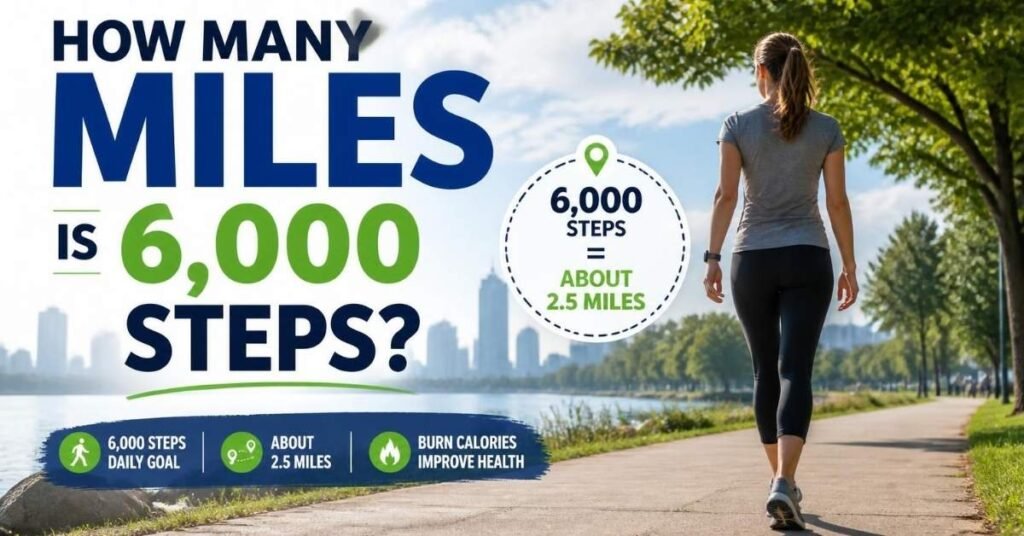

So you hit 6,000 steps on your tracker today. Good for you. But what does that actually mean in miles?
Here’s the short answer. Walking 6,000 steps covers roughly 2.5 to 3 miles. Jogging the same 6K steps gets you closer to 3 to 3.5 miles. Running it out pushes you toward 3.5 to 4.5 miles. The exact number depends on your stride length, your pace, and honestly, your legs.
That’s the quick version. Now let’s break down exactly why the numbers shift, how to calculate your own distance, and whether 6,000 steps is actually enough to move the needle on your health. Grab a coffee. This one’s worth reading in full.
How Many Miles is 6,000 Steps for Different Activities?
The truth is, steps to miles conversion isn’t one fixed number. It changes based on how you’re moving your body.
Think about it this way. A slow stroll around the block uses short, relaxed strides. A jog opens up your hips a bit more. A run stretches your legs even further with each stride. Same 6,000 steps, three completely different distances.
Below, we’ll walk through walking, jogging, and running separately, so you know exactly what to expect no matter how you like to move.
Walking 6K Steps
Walking 6,000 steps typically lands you between 2.5 and 3 miles. Most adults have an average stride length somewhere around 2.2 to 2.5 feet during a normal, casual pace.
If you’re doing a brisk walking session instead of a casual walking stroll, your stride length naturally opens up a little. That bumps your total distance slightly higher, even though your step count stays the same.
Picture a lunch break walk around your office park. That’s usually a moderate pace, and it puts you right around the middle of that 2.5 to 3 mile range.
Jogging 6K Steps
Jogging 6,000 steps covers more ground because your stride length grows to around 3 feet per step. That puts your total distance around 3 to 3.5 miles.
Here’s the thing about jogging. It’s faster than walking but not as demanding as a full sprint. Your body naturally lengthens each stride to cover distance more efficiently, without burning you out too fast.
If you’ve ever done a light jog around your neighborhood before breakfast, you already know this pace. It feels sustainable, and the miles add up faster than you’d think.
Running 6K Steps
Running 6,000 steps stretches your stride to roughly 3.5 to 4 feet, sometimes more if you’re moving at a solid clip. That puts your total distance anywhere from 3.5 to 4.5 miles.
Explosive strides and a faster cadence mean your body covers more ground per step. This is why runners often finish their step count way faster than walkers, even with the same number of steps logged.
If you’ve ever raced past a walking friend and left them behind in what felt like no time, this is exactly why. Longer strides, more efficient coverage, same step count.
Distance Comparison for 6,000 Steps (miles)
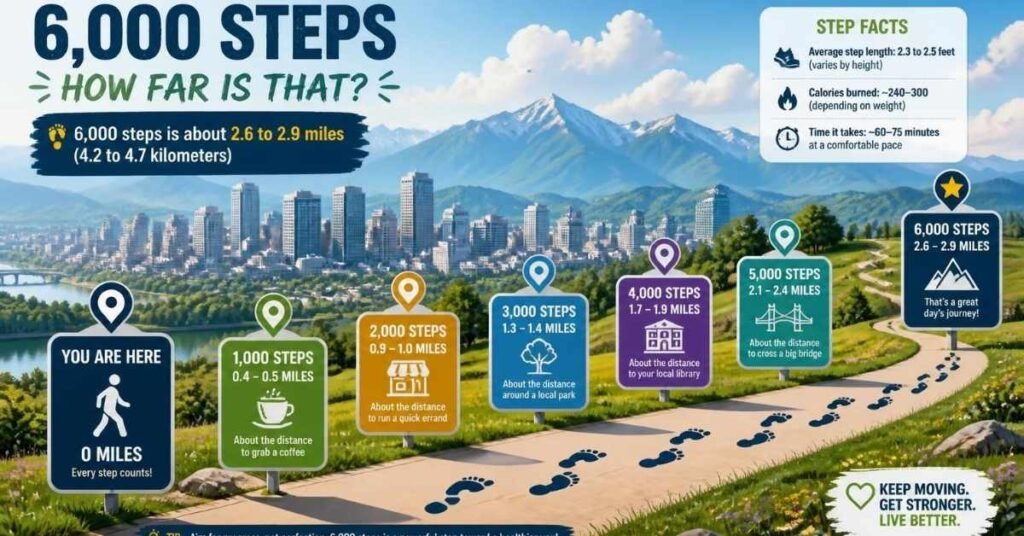
Let’s put all three activities side by side so you can see the full picture at once. This makes it way easier to plan your daily walking routine or pick a fitness goal that actually fits your schedule.
Here’s what stands out immediately. The gap between walking and running isn’t huge in step count, but it’s noticeable in miles. That’s the real value of understanding distance calculation instead of just counting steps blindly.
Quick Comparison Table
| Activity | Average Stride Length | Distance (Miles) | Distance (Kilometers) | Approx. Time |
|---|---|---|---|---|
| Walking | 2.2 – 2.5 feet | 2.5 – 3 miles | 4 – 4.8 km | 50 – 60 min |
| Jogging | 2.8 – 3 feet | 3 – 3.5 miles | 4.8 – 5.6 km | 35 – 45 min |
| Running | 3.5 – 4 feet | 3.5 – 4.5 miles | 5.6 – 7.2 km | 25 – 35 min |
Walking 6K Steps
Look at the walking row again. That 50 to 60 minute window assumes a normal walking pace around 3 mph, which is what most people naturally settle into.
If you slow down for uneven surfaces or a rocky trail, expect that time to stretch out a bit. Terrain matters more than people give it credit for.
Jogging 6K Steps
Jogging shaves off a good 15 to 20 minutes compared to walking the same step count. That’s a solid trade if you’re short on time but still want your cardio boost.
Keep in mind, this assumes a steady jogging pace, not stopping every few minutes to catch your breath. Consistency matters here.
Running 6K Steps
Running gets you done the fastest, but it also demands more from your body. Your heart rate climbs faster, and so does your calorie burn rate.
If you’re newer to running, don’t force a personal record here. Build up your endurance gradually so your fitness level actually improves instead of stalling out from burnout.
How Many Kilometers Is 6,000 Steps?
If miles aren’t your thing, here’s the kilometer conversion. Walking 6,000 steps generally covers 4 to 4.8 km. Jogging bumps that to around 4.8 to 5.6 km. Running pushes it toward 5.6 to 7.2 km.
The math behind miles to kilometers and kilometers to miles is straightforward once you know your stride length in meters instead of feet. Most fitness apps handle this conversion automatically, but it helps to understand it yourself too.
This matters more than you’d think if you’re traveling or using an app that defaults to the metric system. No one wants to misjudge their 6,000 steps distance because of a unit mix-up.
Factors That Affect Your 6K Steps Distance
No two people convert 6K steps to miles the exact same way. Several personal characteristics and biological factors shape your actual distance covered.
Height plays a big role here. Taller people generally have longer legs, which naturally increases stride length. Someone who’s 6’2″ is going to cover more ground per step than someone who’s 5’2″, even walking at the exact same pace.
Age and gender differences matter too. Research on men’s stride length versus women’s stride length shows a measurable gap on average, mostly tied to height and leg length differences. Your body mechanics and even your walking speed habits factor in as well.
Then there’s the environment itself:
- Uphill walking shortens your natural stride
- Pavement walking is more efficient than sand or gravel
- Smooth surface conditions let you move faster with less effort
- Trails with roots or rocks force shorter, more careful steps
Put simply, your 6,000 steps distance is personal to you. Two friends walking together might log the same step count but end up covering slightly different ground.
Formula
Want the exact math? Here’s the formula fitness trackers and researchers actually use for steps to miles conversion.
Miles = (Steps × Stride Length in feet) ÷ 5,280
That 5,280 number comes from the simple fact that there are 5,280 feet in a mile. So if your average stride length is 2.5 feet, and you took 6,000 steps, the math looks like this: 6,000 × 2.5 = 15,000 feet. Divide that by 5,280, and you land right at 2.84 miles.
Want your own stride length? Measure 10 normal steps on a flat surface, then divide the total distance by 10. That gives you a solid, personalized number instead of relying on a generic average.
Health Benefits of Walking 6000 Steps Daily
Here’s where things get genuinely interesting. A well known Northwestern Medicine study, published in the journal Circulation, followed over 20,000 participants across eight separate studies for roughly six years.
The finding? Older adults who walked between 6,000 and 9,000 steps daily had a 40 to 50 percent lower risk of developing cardiovascular disease compared to those who only managed 2,000 steps a day. And here’s the part that surprised a lot of people: pace didn’t matter much. Slow and steady walkers saw benefits just as real as faster walkers did.
That’s genuinely good news if you’ve been intimidated by the old 10,000 steps guideline. You don’t need to hit some magic number to protect your heart health. Even 2,500 to 5,000 steps offers measurable value, and 7,000 to 10,000 steps daily builds on that even further.
Beyond cardiovascular health, walking regularly supports:
- Lower blood pressure and improved circulation
- Reduced stroke risk and fewer heart attacks over time
- Better mood improvement through natural endorphins
- Lower stress hormones and genuine stress reduction
- Improved sleep quality and steadier daily energy
- Support for weight management through consistent calorie burning
On the weight loss front, walking 6,000 steps daily burns roughly 200 to 300 calories for the average adult, depending on weight and pace. Stack that over a month with decent eating habits, and you’re looking at 1 to 2 pounds lost monthly, which is exactly the kind of sustainable weight loss doctors actually recommend, instead of some crash diet that burns out in two weeks.
Does Your Fitness Tracker Get the Math Right?
Here’s a heading you won’t find on most articles about this topic, but it matters. Your Fitbit steps count and Fitbit distance tracking aren’t always perfectly accurate.
Most wearable fitness devices estimate your stride length using your height and a general formula, not your actual walking pattern. That means your fitness tracker might read 6,000 steps as 2.8 miles, while your actual distance covered is closer to 2.6.
The fix is simple. Manually input your real stride length in your app’s settings instead of relying on the automatic guess. This small tweak makes your step tracking and daily activity tracking far more reliable going forward.
Is 6,000 Steps a Realistic Goal for Beginners?
If you’re just starting out, 6,000 steps might sound like a lot. It really isn’t, and here’s why that matters for your long term success.
A beginner-friendly exercise goal should feel doable, not exhausting. Most beginner walking goal recommendations actually start people around 3,000 to 4,000 steps, then build toward 6,000 over a few weeks. This gradual approach keeps you consistent instead of quitting after three days of soreness.
Low-impact exercise like walking is genuinely one of the easiest ways to build an active lifestyle without needing equipment, a gym membership, or any special skill. Just shoes and a sidewalk. That’s the whole barrier to entry.
FAQ’s About Miles Is 6K Steps?
How many miles is 6,000 steps on Fitbit?
Fitbit typically estimates 6,000 steps as around 2.5 to 3 miles, though this depends on the stride length setting in your profile. Update your actual height and stride for a more accurate read.
How many kilometers is 6,000 steps?
Roughly 4 to 4.8 km for walking, slightly more for jogging or running due to longer strides covering extra ground per step.
Does 6,000 steps include running?
Yes. Step counters track movement regardless of activity type, so running, jogging, and walking all contribute to your total step count, even though the distance covered differs.
Can beginners walk 6,000 steps daily?
Absolutely, though easing into it works better long term. Start lower and build up over two to three weeks so your body adjusts without unnecessary strain.
How many calories does 6,000 steps burn?
Around 200 to 300 calories for most adults walking at a moderate pace, with slightly more burned during jogging or running due to higher intensity.
How long does it take to walk 6,000 steps?
Roughly 50 to 60 minutes at a normal walking pace, or closer to 45 minutes if you’re walking briskly.
How many miles are in 6K steps?
Generally 2.5 to 3 miles walking, 3 to 3.5 miles jogging, and 3.5 to 4.5 miles running, depending on your individual stride length.
Can you lose weight by walking 6000 steps a day?
Yes, when paired with a reasonable calorie deficit through diet. Walking alone burns 200 to 300 calories, which adds up to noticeable, sustainable results over weeks and months.
How long of a walk is 6K steps?
About 2.5 to 3 miles, which typically takes under an hour depending on your pace and the terrain you’re walking on.
Is 6k steps a day considered active?
Yes. Research shows measurable health benefits starting well below the old 10,000 step benchmark, and 6,000 steps sits comfortably in the range shown to lower cardiovascular disease risk in older adults.
Conclusion
At the end of the day, 6,000 steps translates to somewhere between 2.5 and 4.5 miles, depending entirely on whether you’re walking, jogging, or running. Your stride length, your pace, and even the walking surface underneath your feet all play a part in the final number.
What matters more than the exact mile count is consistency. Hitting 6,000 steps most days genuinely supports your cardiovascular system, your mood, and your long term wellness routine, backed by real research and not just fitness influencer hype.
So lace up, track your steps, and don’t stress too much over the exact math. Your legs will figure it out one stride at a time.