
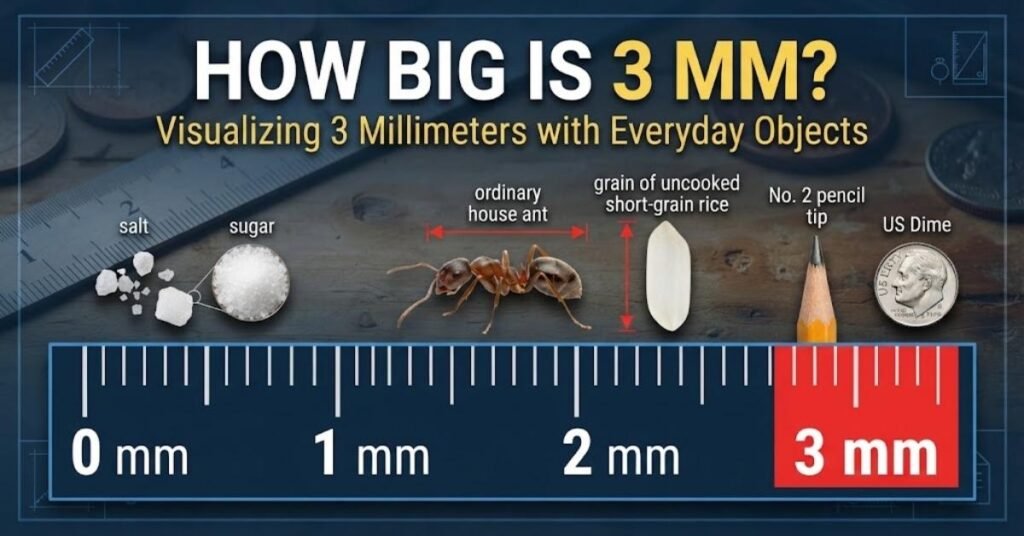

You typed “how big is 3mm” into a search bar for a reason. Maybe you’re buying beads online and the listing says 3mm, but you have no clue what that looks like. Maybe you’re fixing your glasses and the tiny screw that fell out needs a replacement of the exact same size. Or maybe you’re just curious. Whatever brought you here, here’s the short answer: 3mm is about the width of a black peppercorn or the tip of a thick pencil. It’s small, but not invisible. You can see it, you can feel it between your fingers, and once you know what to compare it to, you’ll never need a ruler again.
This guide breaks down nine everyday objects that measure close to 3mm, gives you tricks to estimate this size without any tools, and answers the questions people actually ask about this tiny but important millimeter measurement.
How Big Is 3mm?
Let’s get the numbers out of the way first, because context helps. 3 millimeters equals 0.3 centimeters, or 0.003 meters if you want to go the long way around. In inches, it comes out to roughly 0.118 inches, and in feet, that’s about 0.01 feet. None of these numbers mean much on their own though.
What actually helps is picturing it. Think about the width of a strand of thick spaghetti, or the space between two lines on a ruled notebook page. That’s roughly your 3mm zone. It’s one of those small measurement values that shows up constantly in daily life, from cooking to crafting to fixing electronics, yet most people never stop to think about how tiny it really is until they need to measure something precisely.
This size sits right in that sweet spot. Not so small you’d need a microscope, not big enough to notice unless you’re looking for it. That’s exactly why visual comparison with common objects works so much better than staring at a conversion chart.
How to Estimate 3mm Without a Ruler
You don’t always have a measuring tool handy. Maybe you’re at a craft store deciding between bead sizes, or standing in a hardware aisle trying to guess a screw’s width. Good news: your own body and a few things in your pocket can get you pretty close.
Here’s the thing about estimating without a ruler. It’s not about being perfectly exact. It’s about getting close enough to make a decision, whether that’s buying the right bead size or picking the correct screwdriver bit. These tricks below have saved plenty of people an extra trip back to the store.
Using Your Fingernail
Look at your pinky fingernail. The width of most adult pinky nails sits somewhere between 8mm and 12mm, so 3mm roughly matches the thickness of the white tip at the edge of your nail, the part that grows out past the skin. Hold your finger up to whatever you’re measuring and compare that white edge. It’s rough, but it works in a pinch.
Using Coins or Cards
Coins are surprisingly reliable for quick estimate purposes. A US dime measures about 1.35mm thick, so two stacked dimes get you close to 3mm. If you’re using credit cards, a single card runs around 0.76mm thick, meaning four stacked credit cards land you right around the target. This trick works well because most people have a card or coin within arm’s reach.
Using Everyday Objects
Beyond coins and nails, look around your desk or kitchen. A grain of coarse salt, a peppercorn, or the flat edge of a SIM card all hover near 3mm. Keep a mental note of two or three of these reference objects, and you’ll be able to eyeball measurements almost anywhere without digging out a measuring tool.
Quick Comparison Table
| Object | Approximate Size | Category |
| Black Peppercorn | 3mm diameter | Kitchen |
| Small Jewelry Bead | 3mm diameter | Craft |
| Thick Pencil Tip | 3mm width | Art |
| Tiny Screw Width | 3mm diameter | Hardware |
| Small Seed Bead | 3mm diameter | Craft |
| Earbud Cable Thickness | 3mm width | Electronics |
| Coarse Salt Crystal | 3mm width | Kitchen |
| Thin Plastic Sheet | 3mm thickness | Material |
| Watch Screw Head | 3mm diameter | Precision Tools |
Now let’s walk through each one, because a table only tells half the story.
1. Black Peppercorn
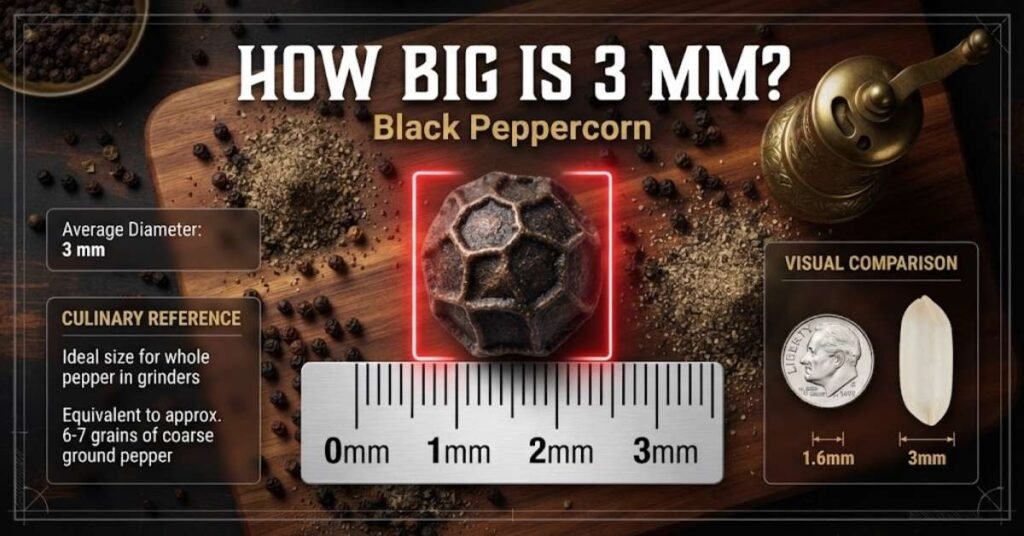
Grab a jar of whole black peppercorns from your spice rack. Roll one between your fingers. That little round kitchen ingredient measures almost exactly 3mm across, give or take a fraction depending on the batch. It’s one of the easiest real-life measurement comparisons because almost every kitchen has a jar of these sitting around.
Chefs and home cooks handle peppercorns daily without thinking about their size, but next time you’re grinding pepper onto your dinner, take a second to notice it. That small round shape is a genuinely useful size comparison example you can reference anytime someone asks how big 3mm actually is.
2. Small Jewelry Bead
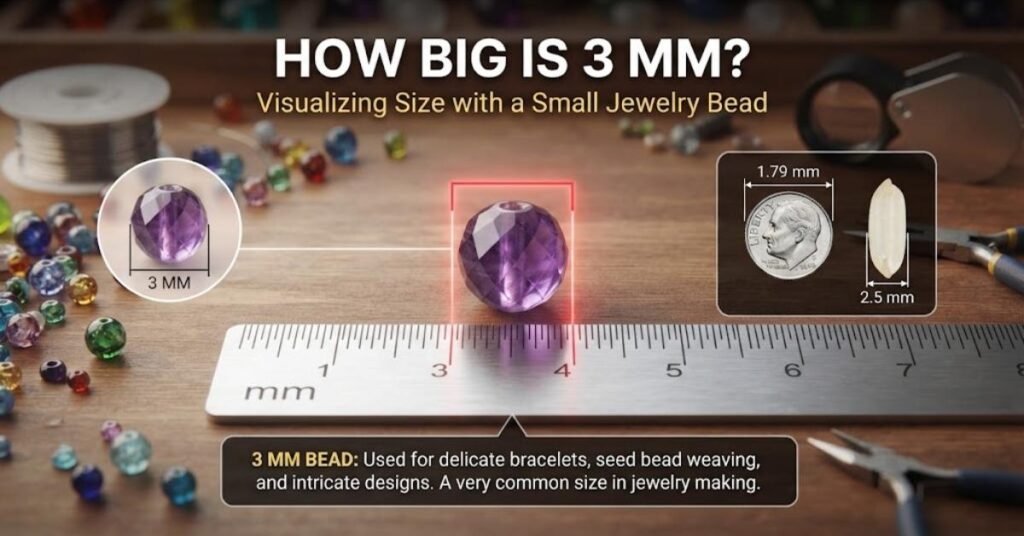
If you’ve ever wandered through a craft supplies aisle, you’ve seen tiny beads labeled by millimeter size. A small jewelry bead measuring 3mm is a popular choice for delicate necklaces, bracelets, and earrings, especially in designs where the beads need to sit close together without overwhelming the piece.
Jewelry makers often choose this exact size because it strikes a balance. Big enough to thread easily, small enough to keep a design looking refined rather than chunky. If you’re shopping for bead measurement specs online and see 3mm listed, picture that peppercorn again. Same ballpark.
3. Thick Pencil Tip
Sketch artists know this one well. A freshly sharpened thick pencil tip, especially on softer graphite grades used for bold lines and shading, often measures close to 3mm in width at the point. Compare that to a standard mechanical pencil lead, which usually runs closer to 0.5mm or 0.7mm, and you can see just how much chunkier this is.
Artists working on sketching or design work sometimes prefer this thicker tip for laying down dark, expressive strokes before refining details with a finer pencil. If you’ve ever wondered why some sketches look bold and dramatic while others look delicate, the pencil thickness is often the reason.
4. Tiny Screw Width
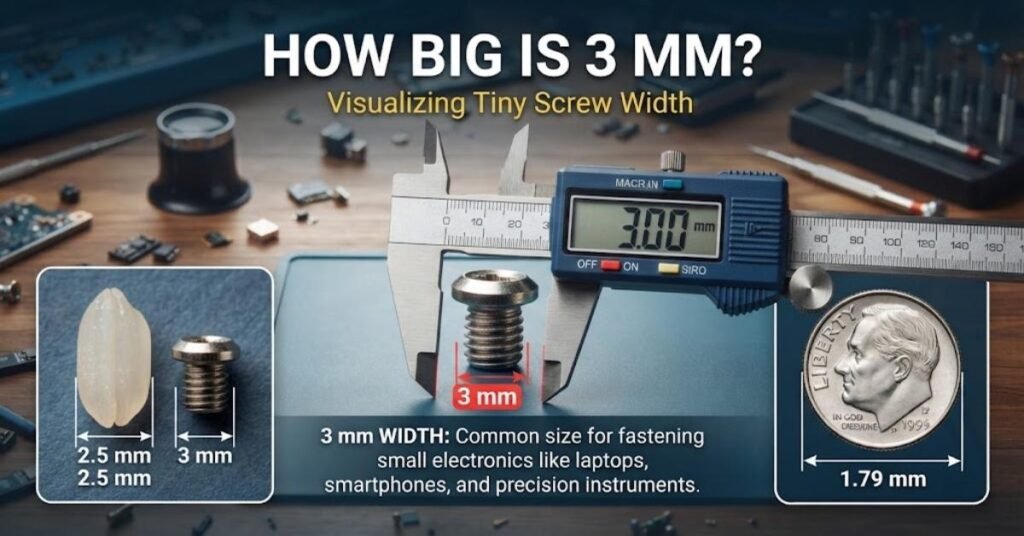
Ever opened up an old pair of glasses or cracked open the back of a phone and spotted screws so small you needed a magnifying glass? Many of these tiny screws used in electronics repair and precision hardware measure around 3mm in diameter.
These aren’t your average hardware store screws. They require a precision screwdriver with interchangeable tips, since a regular screwdriver would strip them instantly. If you’ve ever taken apart a laptop or watch to replace a part, you’ve probably handled a screw this size without realizing exactly how small it was.
5. Small Seed Bead
Slightly different from jewelry beads, a seed bead used in intricate beadwork and embroidery is often sized right around 3mm, sometimes labeled as an “8/0” bead in craft terminology. These tiny craft beads get used in decorative designs, woven patterns, and detailed accessory work where hundreds of beads come together to form a single piece.
Bead sellers typically list exact millimeter sizes because even a half-millimeter difference changes how a pattern lays out. If you’ve ever tried threading beads onto thin wire or thread, you know how much patience a project like this demands, especially at this scale.
6. Earbud Cable Thickness
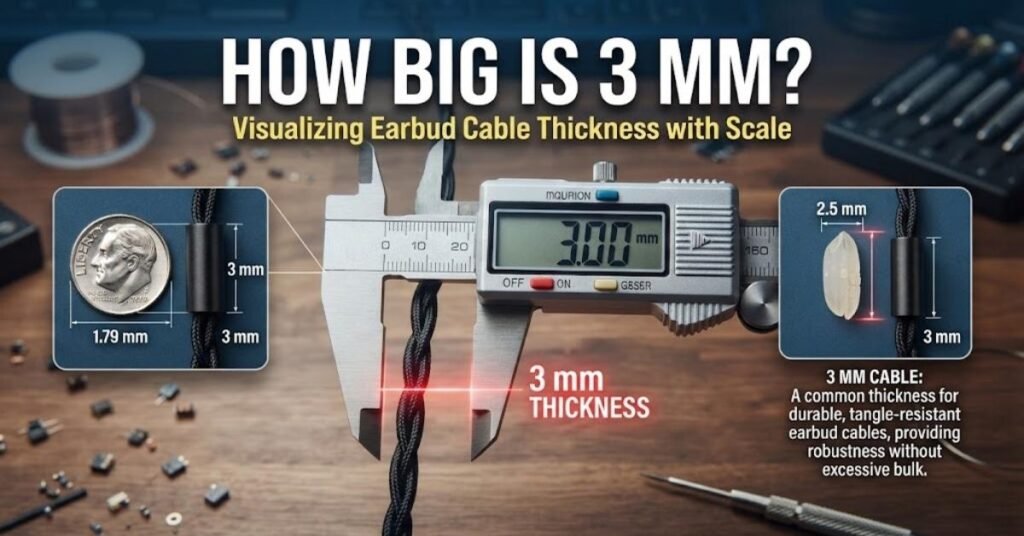
Take a look at your earphones or charging cable the next time you’re untangling them from your bag. Many standard earbud cables measure close to 3mm in thickness, striking a balance between durability and flexibility.
Manufacturers aim for this cable thickness because anything thinner tends to fray or snap too easily, while anything thicker feels stiff and uncomfortable, especially for something you’re wearing near your ears all day. That balance between product durability and comfort is exactly why this size shows up across so many electronics accessories.
7. Coarse Salt Crystal
Different from fine table salt, coarse salt crystals, the kind used for finishing dishes or brining, often measure close to 3mm across individual grains. Next time you’re cooking and reach for a pinch of sea salt flakes or kosher salt, look closely at the crystal size before it dissolves into your dish.
This kitchen ingredient comparison works well alongside the peppercorn example, since both sit in your spice cabinet and both hover around the same tiny size. It’s a small detail, but noticing it makes the whole idea of millimeter measurement feel a lot less abstract.
8. Thin Plastic Sheet
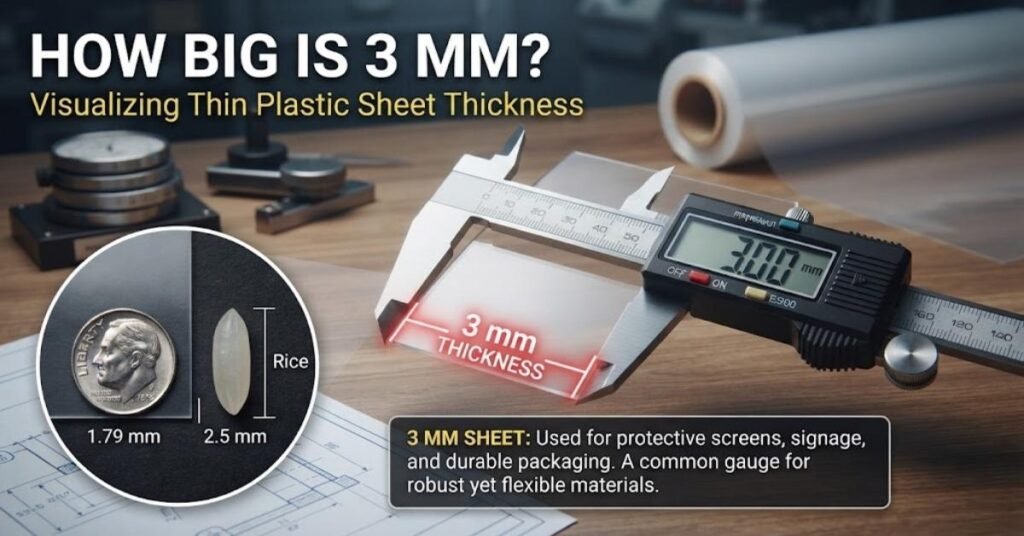
Plastic sheeting used in packaging, protective covers, and certain craft projects often comes in a thin plastic sheet thickness of around 3mm. This isn’t the flimsy plastic wrap you’d find in a kitchen drawer. It’s sturdier, often used for signage, display stands, or protective covers where some rigidity matters but full thickness isn’t necessary.
If you’ve ever picked up a plastic photo frame insert or a lightweight protective panel, there’s a good chance the plastic thickness was somewhere in this range. It holds its shape without adding unnecessary bulk or weight.
9. Watch Screw Head
Inside a mechanical or quartz watch, tiny watch components hold the entire mechanism together, and many of the screw heads used in watch repair measure right around 3mm in diameter, sometimes smaller. Watchmakers rely on a magnifying lens and steady hands to work with parts this size, since dropping one on a workbench often means it’s gone for good.
This level of precision work explains why watch enthusiasts and repair professionals treat these tiny mechanical parts with such care. A movement staying accurate over years depends on components this small fitting together perfectly.
Why This Tiny Measurement Matters More Than You Think
It’s easy to dismiss 3mm as too small to matter, but that’s exactly why it shows up everywhere. Object size at this scale affects product specifications across jewelry, electronics, hardware, and even food packaging. Get it wrong, and a bead won’t thread through the right clasp, a screw won’t fit a specific device, or a cable ends up too fragile for daily use.
For online shopping, this matters even more. When you’re buying products online, especially anything listed by millimeter size like jewelry findings or replacement parts, you can’t physically hold the item before it arrives. That’s why having a mental library of reference objects like a peppercorn or a stack of coins genuinely helps you avoid ordering the wrong size and having to deal with a return.
Students, DIY workers, crafters, and repair workers all run into this measurement more often than they’d expect. Once you start noticing it, you’ll spot 3mm sized items constantly, from the little hex bolts in flat pack furniture to the seed beads in a friend’s handmade bracelet.
3mm vs Other Small Measurements
Sometimes the best way to understand one measurement is to see it next to others. Here’s how 3mm compares to nearby sizes on the scale, since related size comparison often helps things click faster than numbers alone.
| Measurement | Approximate Comparison |
| 2mm | A grain of fine sand or a small map pin head |
| 3mm | A peppercorn or thick pencil tip |
| 5 inches | About the length of a standard matchbox |
| 6 inches | Roughly the width of a smartphone |
| 8 inches | About the length of a dollar bill |
| 12 inches | A standard school ruler |
| 18 inches | Roughly forearm length for most adults |
Seeing 2mm and 3mm side by side helps too. A 2mm object, like a fine grain of sand, feels noticeably smaller once you compare it directly to a peppercorn. That single millimeter of difference actually changes how visible and touchable something feels, which is exactly why unit conversion charts alone rarely tell the full story.
FAQs
How big is 3mm in inches?
3mm converts to approximately 0.118 inches. If you’re rounding for quick math, most people treat it as roughly one-eighth of an inch, though it’s technically just a touch smaller.
What common object is 3mm big?
A black peppercorn is probably the most relatable example, since almost every kitchen has one nearby. A thick pencil tip or a small jewelry bead works just as well if you don’t cook much.
Is 3mm easy to see?
Yes, 3mm is easily visible to the naked eye. It’s not microscopic by any stretch, but it is small enough that fine details, like the threading on a tiny screw or the texture on a watch screw head, often require a closer look or a magnifying lens to appreciate fully.
What does 3mm look like?
Picture a small round dot, roughly the size of a peppercorn or the tip of a thick sketching pencil. It’s small enough to sit on your fingertip with room to spare, but large enough that you’d notice it immediately if it fell onto a table.
How can I estimate 3mm without a ruler?
Stack two dimes together, use four stacked credit cards, or compare it to the white tip of your pinky fingernail. All three tricks get you close enough for everyday decisions like checking measurements before a purchase.
Conclusion
3mm might seem like an oddly specific number to build an entire guide around, but once you start noticing it, you’ll realize how often it quietly shows up. From the peppercorn in your spice rack to the screw holding your glasses together, this small measurement plays a bigger role in daily life than most people ever consider.
Next time a product listing throws a millimeter size at you with no context, you won’t need to search for a conversion chart. Just picture a peppercorn, grab a couple of coins, or glance at your fingernail. You’ve got a built-in reference now, and that’s genuinely useful whether you’re choosing craft supplies, selecting jewelry sizes, or just satisfying your own curiosity about the small stuff.