
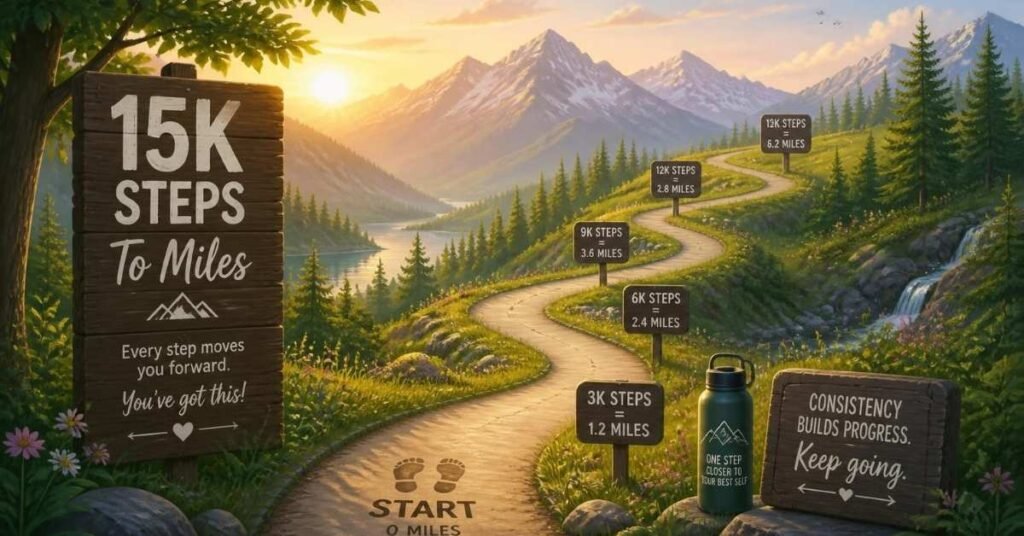

You hit 15,000 steps on your tracker and wonder what that really means. Is it a short stroll or a proper workout? Did you actually cover a decent distance?Here’s the quick answer. For most adults, 15,000 steps equals about 7 miles, or roughly 11 to 12 km, when you walk at a normal pace.
Jogging stretches that to 8.5 to 9.9 miles, and running pushes it to 9.9 to 12.8 miles.Your own number shifts with your height, stride length, and activity type. Let’s break it down so you know where you land.
How Many Miles is 15000 Steps?
The step-to-mile ratio for an average adult sits near 2,000 to 2,400 steps per mile. So 15,000 steps in miles lands between 6.2 and 7.1 miles. That’s the number most people see on a fitness tracker.
Why a range and not one number? Because nobody walks with the exact same step length. A tall person covers more ground per step than a shorter one.
If you want a single figure to remember, go with 7 miles. It’s close enough for daily planning and easy to say out loud.
15000 Steps to Miles Based on Activity Type
Not every step travels the same distance. Slow shuffling, brisk walking, and sprinting all stretch your stride differently. Faster movement means a longer stride, which means more miles per step.
Here’s how the three main activity types compare:
| Activity | Feet per step | Miles | Kilometers |
| Casual walking | 2.0 to 2.3 feet | 5.7 to 6.5 miles | 9 to 10.5 km |
| Brisk walking | 2.5 to 2.8 feet | 7.1 to 8.0 miles | 11 to 13 km |
| Light jogging | 3.0 to 3.5 feet | 8.5 to 9.9 miles | 13 to 16 km |
| Running | 3.5 to 4.5 feet | 9.9 to 12.8 miles | 16 to 21 km |
15000 Steps Walking Distance

At an easy walking pace, you’ll cover about 5.7 to 6.5 miles. Speed things up to walking fast, around 3 to 4 mph, and you’ll land closer to 6.8 to 7.5 miles.
Most daily walkers fall in the middle. If you’re strolling to the shops and back, expect the lower end of the range.
15000 Steps Jogging Distance

Jogging stretches your stride length to about 3.0 to 3.5 feet. That puts 15,000 steps at roughly 8.5 to 9.9 miles.
Picture a light jogging session at 5 mph. You’d finish in under two hours and cover close to 9 miles.
15000 Steps Running Distance

Running opens your extended stride to 3.5 to 4.5 feet per step. So 15,000 steps means 9.9 to 12.8 miles, sometimes more for competitive runners.
Here’s a fun comparison. A half marathon is 13.1 miles, so a fast runner can nearly finish one on step count alone.
How Many Kilometers Is 15,000 Steps?
Not everyone thinks in miles. For kilometers, walking 15,000 steps gets you about 11 to 12 km. Jogging lands around 13 to 16 km, and running reaches 16 to 21 km.
The steps-to-kilometers conversion is simple. Take your miles and multiply by 1.609.
So 7 miles becomes about 11.3 km. Use that quick math whenever your smartphone step tracker shows only one unit.
How Long Does It Take to Complete 15000 Steps?
Time depends on your walking speed and your cadence, meaning steps per minute. At about 100 steps a minute, 15,000 steps takes 150 minutes. That’s 2.5 hours of total movement.
Of course, you don’t need to do it all in one go. Most people spread it across the day through errands, work breaks, and an evening walk.
Here’s a rough guide:
- Casual walking at 2.5 mph: about 2.5 to 3 hours
- Brisk walking at 3 to 4 mph: about 2 to 2.5 hours
- Light jogging: about 1.75 to 2 hours
- Running at a 10-minute mile pace or faster: about 1 to 1.5 hours
15000 Steps Calories Burned & Health Benefits
How many calories does a 15K step walk burn? For most people, walking burns about 500 to 800 calories. Jogging runs 700 to 900 calories, and running can reach 900 to 1,200 calories.
Your body weight matters a lot here. A 130 lbs person burns less than someone at 200 lbs, because heavier bodies spend more energy moving the same distance.
Beyond burning energy, daily movement helps heart health and cardiovascular fitness. It can also support better metabolism, steadier mood, and better sleep for many healthy adults.
Here’s a quick example. Imagine a friend at 150 lbs who walks 15K steps most days. She’d burn roughly 600 calories each day, which adds up fast over a month.
Factors That Affect Your 15000 Steps Distance
Two people can both log 15K steps and finish with different miles. Several things change the result:
- Height and leg length: taller people take longer steps
- Gender: the average man often has a slightly longer stride than the average woman, mostly due to height
- Terrain: hilly terrain and uphill walking shorten your steps
- Age and fitness level: older adults and beginners often take shorter steps, while trained athletes stretch theirs
- Pace: faster movement means a longer stride
Stride consistency matters too. If you shuffle one day and power walk the next, your daily distance will bounce around.
Don’t stress about small gaps. Your tracker gives you a solid estimate, and your trend over weeks matters more than any single day.
How to Calculate Your Personal Distance
Want your exact number? You can work out your personal stride length in under a minute. Use this distance formula:
Distance (miles) = Steps × Stride Length ÷ 5,280
There are 5,280 feet in a mile. Your stride length in feet is what you plug in.
To estimate it, multiply your height in inches by 0.413 if you’re a woman, or 0.415 if you’re a man. Then divide by 12 to get feet.
Let’s try a real example. Say you’re 5’8″, which is 68 inches. Multiply 68 by 0.413 and you get about 28.1 inches, or 2.34 feet per step.
Now do the steps-to-miles conversion. 15,000 × 2.34 ÷ 5,280 gives you about 6.65 miles.
Here’s a quick cheat sheet by height for walking:
- 5’0″: roughly 5.7 miles
- 5’4″: roughly 6.2 miles
- 5’8″: roughly 6.65 miles
- 6’0″: roughly 7.1 miles
- 6’4″: roughly 7.5 miles
Want an even more accurate number? Walk 100 steps on flat ground, measure the distance, and divide by 100. That gives you your true step length.
15,000 Steps vs 10,000 Steps: What’s the Real Difference?
The standard 10,000-step recommendation gets you about 4.5 to 5 miles. Moving up to 15,000 steps adds roughly 50 percent more activity. That’s about 2 extra miles each day.
Is the jump worth it? For fitness and weight management, often yes. For general health, many studies suggest the biggest gains arrive well before 15K, so it’s more of a bonus.
Think of it this way. 10K steps keeps you healthy. 15K steps pushes you toward a bigger calorie deficit and stronger endurance.
How to Reach 15,000 Steps Without Wrecking Your Day
Hitting 15,000 daily steps feels huge on paper. In practice, small habits stack up quickly.
Here are easy ways to get there:
- Take a 15 minute walk after each meal
- Pace during phone calls
- Park far from the entrance
- Take the stairs instead of the lift
- Walk to a coffee spot instead of ordering in
Supportive shoes make a real difference at this volume. Your feet and joints carry thousands of extra impacts, so cushioning matters. Build up with a gradual increase of about 1,000 steps a week.
Conclusion
So, how many miles is 15K steps? Around 7 miles for most walkers, 8.5 to 9.9 miles for joggers, and up to 12.8 miles for runners. Your height, pace, and terrain decide the rest.Use the distance formula above to find your exact number. Then let your step tracker do the daily counting.
What’s your usual step count, and how many miles does your Fitbit or Apple Watch show? Drop it in the comments, and share this with a friend who loves chasing step goals.
FAQs
How many miles is 15,000 steps on Fitbit?
A Fitbit estimates distance using your height and gender. For most people, 15,000 steps shows about 6.5 to 7.5 miles. Set your stride length manually in the app for a more accurate reading.
Is 15,000 steps enough exercise?
Yes, for most healthy adults. It easily beats the common guideline of 150 minutes of weekly physical activity. Pair it with some core exercises and strength work for a balanced routine.
Can I walk 15,000 steps every day?
Many people do, and it’s generally safe if you build up slowly. Wear supportive shoes and rest if something hurts. If you have a health condition, check with your health care provider first.
How many hours does 15,000 steps take?
Expect about 2 to 3 hours of total walking. Faster walking trims that to around 2 hours, and jogging cuts it to under 2.
How much weight can I lose walking 15,000 steps daily?
Walking burns about 500 to 700 extra calories. With a steady diet, that can mean 1 to 2 pounds per week. Results depend on your starting weight and diet quality.
Does 15,000 steps include running?
Yes. Your tracker counts every step, whether you walk, jog, or run. Running just covers more miles for the same count.
Will I lose weight if I walk 15000 steps a day?
Probably, if you stay in a daily calorie deficit. Walking helps, but a balanced diet does half the work. Overeating can cancel out those burned calories.
How many calories do you burn in 15000 steps?
About 500 to 800 calories walking, depending on body weight and pace. Jogging and running burn more.
Is 15000 steps considered very active?
Yes. It sits well above the 7,500 to 10,000 range often labeled active. At this level, you qualify as a very active person for daily movement.
How long is a 15000 step walk?
Roughly 7 miles or 11 to 12 km. Most people finish in 2 to 2.5 hours at a comfortable pace.
Is 16k steps a lot?
It’s slightly more than 15K steps, about 7.5 miles for most walkers. For active people, it’s a solid but manageable daily goal.
Is walking 20,000 steps a day too much?
Not automatically. Many fit people handle it fine. Build up slowly, and watch for joint pain, excessive fatigue, or an injury.
How many steps to lose 10 kg?
You’d need about 77,000 calories of deficit for 10 kg (about 22 pounds). At 600 calories burned per day from walking, that takes around four to five months, paired with a calorie-controlled diet.
Can walking get you a flat stomach?
Walking helps reduce overall body fat, including belly fat and visceral fat. You can’t spot-reduce your stomach fat though. Combine walking with core exercises and balanced nutrition for visible results.