
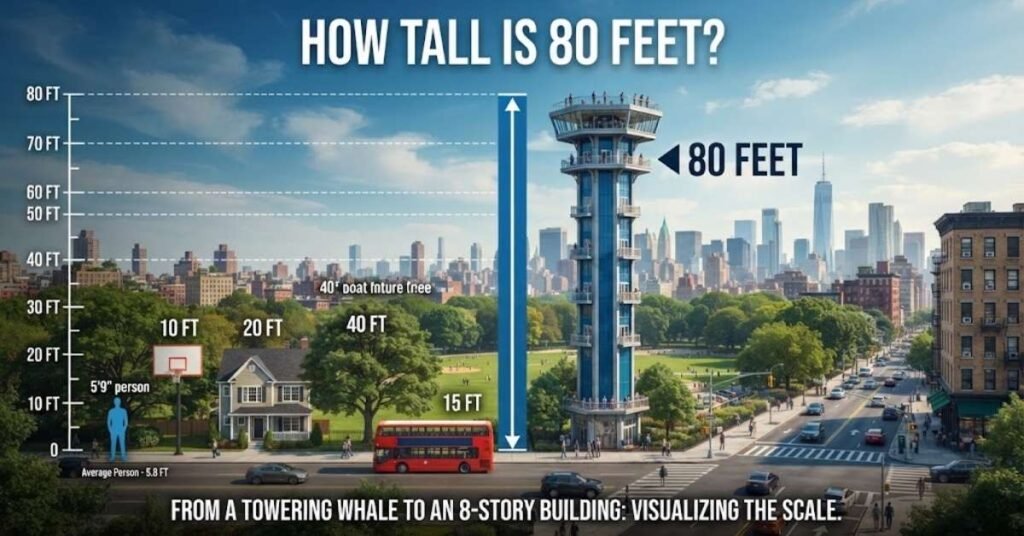

Ever read a number like 80 feet and thought, “Okay, but how long is that really?” You’re not alone. Numbers on a page don’t give you a feel for distance.Here’s the quick answer. 80 feet equals 960 inches or 24.384 meters.
Picture a semi-truck with trailer, two yellow school buses parked bumper to bumper, or a blue whale gliding through the ocean. Below, you’ll find 12 real-world examples that make 80 feet long easy to see.
How Long Is 80 Feet?
80 feet is a horizontal distance of about 24.4 meters. In smaller measurement units, that’s 2,438.4 centimeters or 24,384 millimeters. In bigger ones, it’s 26.6667 yards, 0.024384 kilometers, or 0.0152 miles.
Numbers like these are accurate, but they don’t stick. Your brain needs a mental model. That’s why everyday objects work so well as a visual reference.
If you walk it, you’ll cover 80 feet in about 32 steps. That’s based on an average adult stride of 2.5 feet. Try it in your driveway or a parking lot, and you’ll feel the length instantly.
Quick Conversion Table for 80 Feet
Need the feet to meters math fast? Here’s a simple table you can screenshot.
| Unit | Value for 80 feet |
| Inches | 960 inches |
| Yards | 26.6667 yards |
| Meters | 24.384 meters (about 24.4 meters) |
| Centimeters | 2,438.4 centimeters |
| Millimeters | 24,384 millimeters |
| Kilometers | 0.024384 kilometers |
| Miles | 0.0152 miles |
Quick tip: to go feet to meters, multiply by 0.3048. That’s the only number you need to remember.
Vehicles & Transportation — Things That Are 80 Feet Long on the Road
Roads give you the easiest comparisons. You see these vehicles every day, usually without thinking about their size. Once you do, 80 feet stops feeling abstract.
Both examples below sit on American highways all the time. Let’s start with the biggest one.
Semi-Truck with Trailer

A semi-truck with trailer is one of the best matches for 80 feet. A truck cab from brands like Peterbilt or Kenworth pairs with a 53-foot trailer. Depending on the cab and the coupling, the full rig usually lands between 70 and 80 feet.
Next time you pull up behind one at a loading dock or on the interstate, count the length. It’s a rolling life-size model of this measurement. The longest rigs come very close to 80 feet.
Here’s a trick. If the truck and trailer fill your windshield from edge to edge, you’re probably staring at something near 80 feet.
Two School Buses Combined
A full-size yellow school bus runs roughly 35 to 40 feet long. Park two school buses nose to tail, and you land right around 80 feet. Simple, right?
Think about the pickup line outside an elementary school. Two buses idling in a row make a perfect end-to-end comparison. Most people have a clear picture of that scene.
This one also helps with passenger capacity thinking. Two buses can carry well over 100 kids, so 80 feet of road can hold a lot of backpacks.
Nature & Animals — 80 Feet Long in the Natural World
Nature doesn’t follow a ruler. Still, a few giants land close to 80 feet. They show how big the natural world can get.
One swims, and one stands still. Both can make you feel tiny.
Blue Whale

The blue whale is the largest living animal and Earth’s largest animal. A mature blue whale commonly measures about 75 to 80 feet, and some stretch closer to 100 feet. NOAA Fisheries tracks this marine mammal and lists its size among the biggest ever recorded.
Want to see one without a boat? The American Museum of Natural History in New York hangs a life-size model of a blue whale from its ceiling. It measures 94 feet, so you can stand beneath it and look up.
That’s a great ground-level experience of whale length. Even a slightly smaller whale at 80 feet would outsize a semi-truck.
Mature Oak Tree
Now think vertical. A mature oak tree, like a white oak or red oak, can climb to around 80 feet in good conditions. That’s how tall 80 feet really is, and it’s taller than most houses by a mile.
Height depends on soil conditions, climate, and age. The United States Forest Service studies these deciduous trees across North American forests. Not every oak reaches 80 feet, but healthy old ones often do.
Next time you hike, look straight up at a big oak. You’re seeing 80 feet of nature in one trunk.
Sports & Recreation — 80 Feet Long on the Court and Lane
Sports facilities are measured with care, so they make reliable yardsticks. You may have stood in these spaces without noticing the exact numbers. Let’s fix that.
Both examples sit within a few feet of 80 feet. That makes them handy for 80 feet comparison in daily life.
Tennis Court
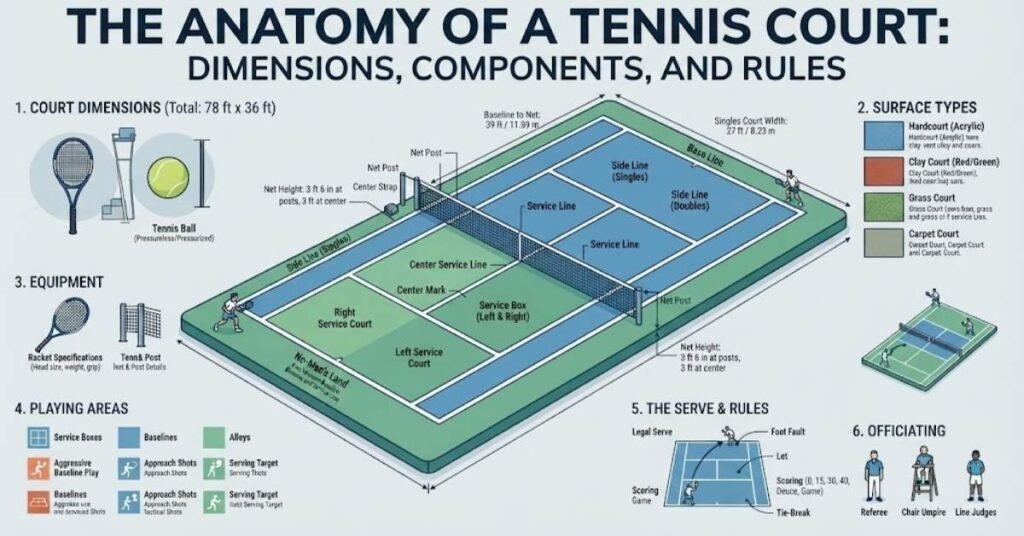
A regulation tennis court is 78 feet from baseline to baseline. That’s the standard tennis court length set by the International Tennis Federation. ITF court standards apply to singles and doubles tennis court play alike.
So tennis court length is just 2 feet shy of 80 feet. Try standing at one baseline and looking across to the other. That view is almost exactly what 80 feet looks like.
Here’s a bonus detail. The doubles tennis court is wider than the singles court, but the length stays at 78 feet.
Bowling Lane
A regulation bowling lane measures 60 feet from the foul line to the head pin. Add the bowling approach, which is at least 15 feet, plus the pin deck, and you reach roughly 78 feet.
Next time you bowl, notice how far away the bowling pins feel. That distance gives you a gut sense of 80 feet. It’s long enough that the pins look tiny from the foul line.
Want a fun comparison? The lane plus approach is also shorter than a standard NBA basketball court, which stretches 94 feet.
Buildings & Structures — 80 Feet Long in Architecture
So far, we’ve gone sideways. Buildings let you tip 80 feet upright. Suddenly the vertical distance becomes very real.
Both examples below work in cities, suburbs, and campuses. You’ll spot them in no time.
8-Story Building

An 8-story building is a handy way to picture 80 feet. Planners often use about 10 feet per story as a quick rule, which gives ground-to-roof height near 80 feet. Real floor height varies, and many commercial buildings run taller, closer to 100 feet.
You’ll find an eight-story building in city centers, suburban office parks, and university campuses. It’s a classic mid-rise structure. Both residential building and office versions follow similar proportions.
Stand at the bottom and look straight up at the roofline. That’s how tall 80 feet feels. American building codes and urban planning rules shape these heights, so they stay fairly consistent.
Four Shipping Containers in a Row
A standard shipping container is usually 20 feet long. Line up four shipping containers end to end, and you get 80 feet. Two 40-foot ones would do the same job.
These ISO shipping containers are everywhere in freight logistics. You’ll see them stacked at industrial ports and on trains. A row of four is an easy industrial representation of 80 feet.
Here’s why this one is so useful. Intermodal shipping containers are built to a strict size, so there’s no guessing. That makes it a very honest visual comparison.
Industrial & Technology — Things That Are 80 Feet Long in Engineering
Industry builds big things. Engineers care about every foot, so the numbers are exact. These two examples show 80 feet in motion and on rails.
One spins in the wind. The other carries travelers across the country.
Wind Turbine Blade

An 80-foot wind turbine blade is a serious piece of engineering. It stretches from the blade root to the blade tip, and it sits on a tall turbine tower. Blades this size suit older or smaller onshore wind turbines.
To be clear, modern utility-scale blades have grown much longer, often well beyond 150 feet. Still, an 80-foot blade makes a great mental picture. It’s a single industrial component you could lay across a football field.
You’ll see them across the American Midwest, where wind energy is big business. The U.S. Department of Energy tracks wind power and renewable energy growth. Makers like GE and Vestas build these giants.
Railroad Passenger Car
A railroad passenger car is close to 80 feet. An Amtrak Superliner measures about 85 feet, which puts it in the 80 to 90 feet range. That’s a long-haul passenger car built for comfort.
Amtrak runs intercity rail across the U.S. rail network. Walk down one aisle, and you’ll feel that length in your legs. A single passenger car can hold dozens of people and their bags.
If you’ve ridden a train through the country, you’ve already lived inside 80-ish feet of transportation.
Water & Marine — 80 Feet Long on the Water
Boats give us a different way to see length. On water, size shows up fast. A marina makes the comparison easy.
Here are two vessels that sit right around 80 feet. One is for pleasure, and one is for work.
Large Luxury Yacht

An 80-foot yacht is a large luxury yacht. At about 24.4 meters, it sits right at the edge of what many call a superyacht. Yards like Hatteras Yachts have built yacht manufacturers’ models in this size range.
Expect private cabins, multiple decks, and real offshore capability. These boats handle ocean cruising as well as coastal waters. At a marina dock, an 80-footer towers over most boats around it.
It’s a great way to picture 80 feet. You could fit about 2 school buses on its deck, roughly speaking.
Commercial Fishing Boat
A commercial fishing boat is built for work, not looks. Many fishing vessels, like an offshore trawler or longliner boat, run around 80 feet. They head out on deep-water trips and need strong open-ocean performance.
NOAA Fisheries oversees commercial fishing in U.S. coastlines waters. Walk through any of the American harbors, and you’ll spot these workhorses. Their size often surprises first-time visitors.
Compared with the luxury yacht, the function is different. But the length is similar. Both help you picture 80 feet long in real life.
How to Visualize 80 Feet Without a Tape Measure
You don’t always have a semi-truck nearby. So here are three simple ways to visualize 80 feet anywhere.
- Walk it: take about 32 steps with a 2.5-foot stride.
- Use cars: a typical sedan is about 15 feet, so line up 5 or 6 of them.
- Use a house: many single-family homes are 40 feet wide, so picture two side by side.
Each trick turns picturing 80 feet into a quick real-life measurement. Try one the next time you’re measuring a fence or a garden.
80 Feet Compared With Other Common Lengths
Context helps. Here’s how 80 feet stacks up against other familiar related measurement comparisons.
| Length | What it looks like |
| 20 feet | One short shipping container |
| 60 feet | Bowling lane from foul line to head pin |
| 78 feet | Tennis court baseline to baseline |
| 80 feet | The target of this guide |
| 94 feet | NBA basketball court or the museum whale model |
Notice how many things cluster between 75 and 85 feet. That’s why this length shows up so often in daily life.
Common Mistakes When Estimating 80 Feet
Most people guess too short. Outdoors, horizontal distance tricks the eye, especially without nearby objects. A field can look half its true size.
Another mistake is mixing up height and length. How tall is 80 feet is a different picture than how long is 80 feet. Tip a tennis court on its end, and you’ve got a very tall tower.
Last, don’t trust one example. Use two or three familiar objects together. It makes your estimate far more reliable.
Conclusion
80 feet is easier to grasp than it looks. It’s about 24.4 meters, 960 inches, or 32 steps. From a semi-truck with trailer to a blue whale, the real-world examples are everywhere.Pick your favorite from this list and use it next time you need a visual reference.
Which one surprised you most? Drop a comment below, and share this with a friend who loves everyday objects trivia.We’ll keep this guide fresh through 2026, so check back for updates.
FAQs
How long is 80 feet visually?
It’s about the length of a semi-truck with trailer, two school buses, or a tennis court plus a couple of feet. Think of a bowling lane with the approach.
How many steps does it take to walk 80 feet?
About 32 steps for most adults. That’s based on a 2.5-foot stride from a standing start.
How tall is an 8-story building in feet?
Roughly 80 feet if you use 10 feet per story. Many commercial buildings are taller, so expect 80 to 100 feet or more.
Is 80 feet longer than a basketball court?
No. An NBA basketball court is 94 feet long, so 80 feet is about 14 feet shorter.
What is 80 feet in meters?
80 feet equals 24.384 meters, often rounded to 24.4 meters. Multiply feet by 0.3048 to convert.
How many school buses equal 80 feet?
About two school buses. Each runs roughly 35 to 40 feet, so two fill the distance.
What animal is approximately 80 feet long?
The blue whale. Many adults are 75 to 80 feet, and some reach close to 100 feet.