


Quick answer: 5 miles equals about 10,000 to 12,000 steps when you walk. Running cuts that to roughly 8,000 to 9,500 steps, since your running stride is longer. Your exact number depends on your height, pace, and the ground under your feet.Maybe you just finished a long walk and your watch shows 11,200 steps. Now you’re wondering if you hit five miles or fell short.
Or maybe you’re planning a charity walk and want to know what you’re signing up for.This guide answers both worries. You’ll get clear numbers, a steps-to-miles chart, and a simple way to find your own personal step count. Grab your shoes and let’s get into it.
5-Mile Step Count
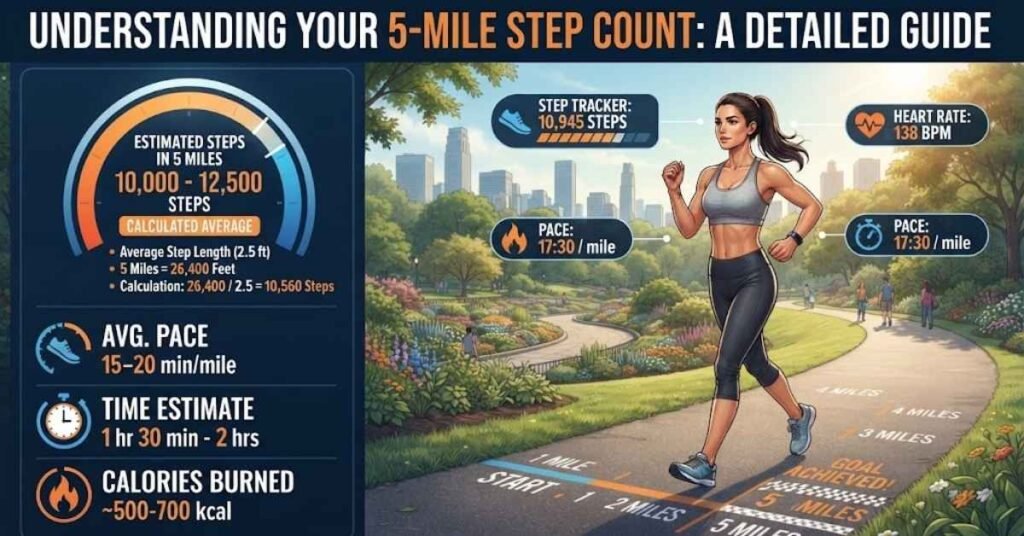
The 5-mile step count isn’t one fixed number. It’s a range, and that range comes from one simple fact about distance.
Five miles equals 26,400 feet, because one mile has 5,280 feet.
To get your steps in 5 miles, divide those 26,400 feet by the length of one step. Longer steps mean fewer steps.
Shorter steps mean more. That’s the whole game.
How Many Steps Is 5 Miles of Walking?
Most adults take a natural stride length between 2.2 and 2.5 feet while walking. Plug those into the math and you get 10,560 to 12,000 steps.
So when people ask how many steps in 5 miles of walking, “around 11,000” is a safe middle ground.
Men usually land near the lower end, since the average male stride length runs about 2.5 feet. Women often land near the higher end, with an average female stride length around 2.2 feet.
That’s not a rule. It’s mostly height and stride length doing the talking.
How Long Does It Take to Walk 5 Miles?
How long does it take to walk 5 miles? Most people finish in about 1 hour and 40 minutes at an easy, steady pace.
A brisk walker can do it in one hour and 15 minutes, while a slow stroll stretches closer to two hours and 30 minutes.
Think of it like a commute. If you walk to work at 3 mph, a five-mile route eats up most of your morning.
But at 4 mph, you’d be done before your coffee gets cold.
How Many Steps Is 5 Miles of Running?
Running changes everything. Your feet leave the ground, your body flies forward, and each stride covers more distance.
A runner’s average stride is often 3 to 3.5 feet, so running five miles takes roughly 8,000 to 9,000 steps.
Some people land closer to 9,500 steps if they run slowly with short, quick strides. Others stay near 7,500 if they float along with long, bouncy ones.
So if you’re asking how many steps to run 5 miles, think “about 8,800” as a handy middle number.
Steps in 5 Miles by Walking Speed
Speed affects both time and, a little, step length. The table below shows what to expect at common walking speeds in mph.
| Walking Speed | Time for 5 Miles | Estimated Steps |
| 2 mph (slow walking) | 2 hours 30 minutes | 11,500 to 12,500 |
| 2.5 mph (easy pace) | 2 hours | 11,000 to 12,000 |
| 3 mph (normal walking) | 1 hour 40 minutes | 10,500 to 11,500 |
| 4 mph (brisk walking) | 1 hour 15 minutes | 10,000 to 11,000 |
Notice the pattern. Faster walking pace usually stretches your stride, which trims the total.
These are estimates, so treat them as a starting point rather than gospel.
Key Factors That Change Your 5-Mile Step Count
Two people can walk the same five miles and end up thousands of steps apart. That’s normal.
Here’s what moves the needle.
Height and Stride Length Impact
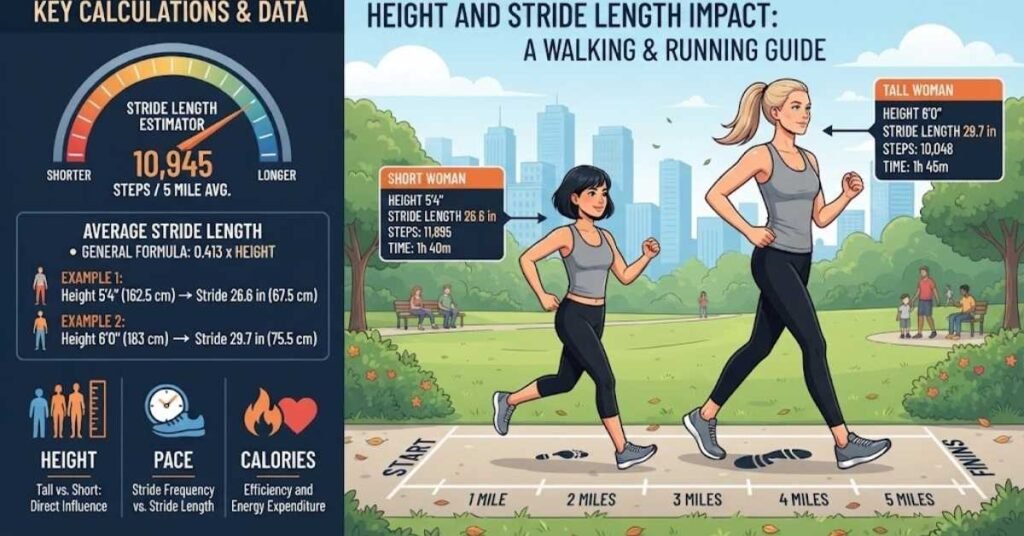
Taller people have longer legs, so they cover more ground per step. A simple rule of thumb says your walking stride length equals about 41% of your height.
A 5-foot-4 woman has a shorter step length than a 6-foot-2 man, so she’ll rack up more steps over the same distance.
One quick note on words. A “step” is one foot landing, while a “stride” technically means two steps.
Most fitness apps and this guide use the casual meaning, so a stride and a step are treated as the same thing.
Walking Speed and Terrain Effects
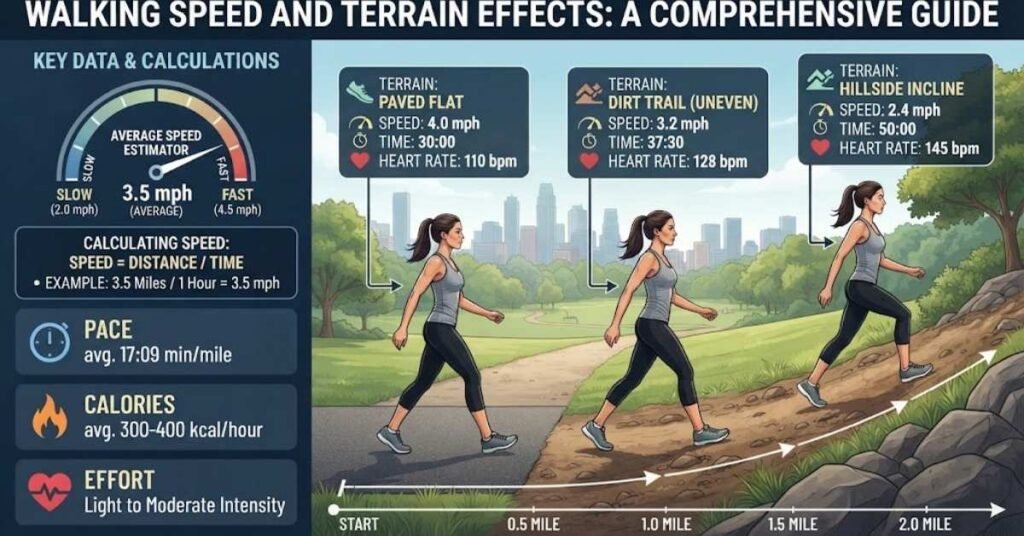
Terrain sneaks up on you. Uphill walking shortens your steps because you’re fighting gravity, while downhill walking can lengthen them or make you take careful little steps.
Trudging through snow or loose sand forces tiny steps too, so your count climbs fast.
Flat indoor tracks give the cleanest numbers. Uneven outdoor surfaces, strong wind, and bad weather all push your step count variations higher.
A hilly trail walk of five miles can easily add 500 to 1,000 steps compared with a treadmill.
Steps in 5 Miles by Running Pace
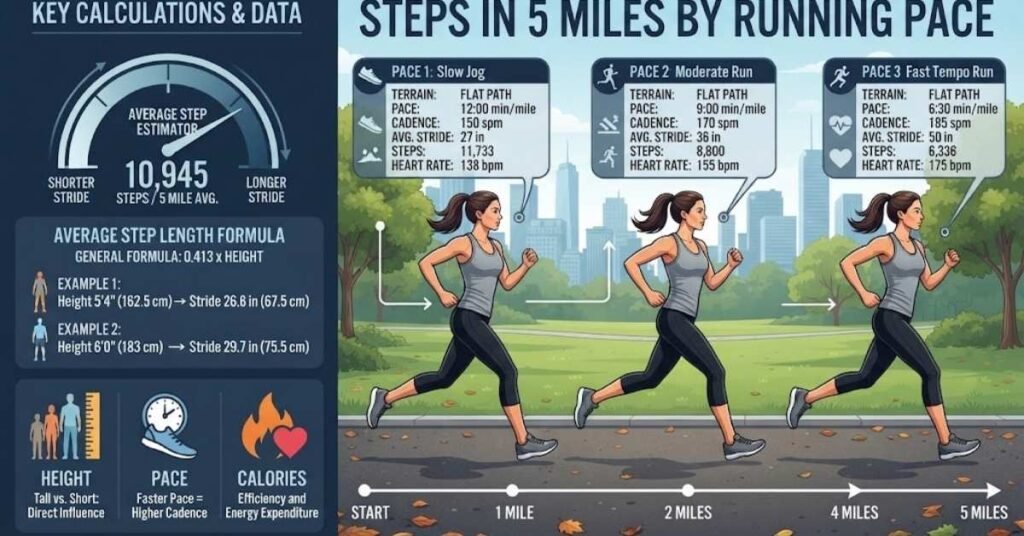
Your running pace per mile matters just as much. A faster pace means a longer stride and fewer steps, while a slow jog often means shorter, choppier ones.
| Running Pace | Time for 5 Miles | Estimated Steps |
| 12-minute mile (easy jog) | 1 hour | 9,000 to 9,500 |
| 10-minute mile | 50 minutes | 8,800 to 9,200 |
| 8-minute mile | 40 minutes | 8,300 to 8,800 |
| 6-minute mile | 30 minutes | 7,500 to 8,000 |
Steps per minute, also called step frequency, usually sits between 160 and 180 for most runners.
That steady rhythm is why a faster runner covers distance with fewer ground contacts.
Steps to Miles Chart
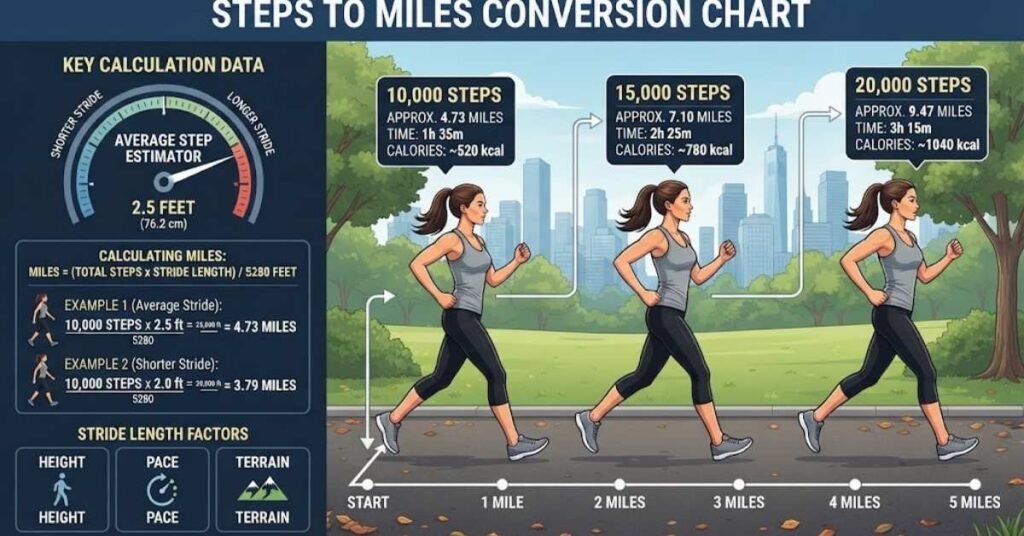
Need a quick lookup? This steps-to-miles chart assumes an average walking stride of about 2.3 feet.
Use it for fast steps-to-miles conversion when you don’t feel like doing math.
| Distance | Approximate Steps |
| 1 mile | 2,300 |
| 2 miles | 4,600 |
| 3 miles | 6,900 |
| 4 miles | 9,200 |
| 5 miles | 11,500 |
| 10 miles | 23,000 |
Going the other way, 2,000 steps is close to one mile. And 4,000 steps gets you near two miles.
So miles-to-steps conversion is easy once you know your own stride.
The 10,000 Steps Connection

The 10,000-step goal shows up everywhere. Fitness bands buzz when you hit it, and doctors mention it in casual advice.
But where did it come from, and does it really equal five miles?
Here’s the surprise. It started as a marketing idea, not a medical rule.
More on that in a moment.
How Many Miles Is 10,000 Steps?
For most people, 10,000 steps equals 4 to 5 miles. With a 2.5-foot stride you’d cover about 4.7 miles.
With a 2.2-foot stride, you’d cover closer to 4.2.
So if you’re hoping to walk 5 miles and your counter says 10,000, you’re probably a little short. Add another 1,000 to 2,000 steps and you’ll cross the line.
That’s about 10 to 15 extra minutes of walking.
Is 10,000 Steps Always 5 Miles?
No. It can land at 4.5 miles, 5 miles, or 5.5 miles depending on your stride. A tall person with long steps might reach five miles before step 10,000.
A shorter person might need 12,000 or more.
The number also has an odd backstory. A Japanese company sold a Japanese pedometer called the Manpo-kei, which means “ten-thousand-step meter,” during a 1960s marketing campaign tied to the Tokyo Olympics.
The round number stuck because it sounded nice, and it caught on worldwide.
Average Steps in 5 Miles by Height
Height is the biggest single factor, so here’s a quick guide. These numbers use the 41% stride rule and are close estimates, not exact measurements.
| Height | Approx. Walking Stride | Steps in 5 Miles |
| 4’10” | 2.0 ft | 13,200 |
| 5’0″ | 2.07 ft | 12,800 |
| 5’2″ | 2.13 ft | 12,400 |
| 5’4″ | 2.2 ft | 12,000 |
| 5’8″ | 2.34 ft | 11,300 |
| 5’10” | 2.41 ft | 11,000 |
| 6’0″ | 2.48 ft | 10,650 |
| 6’2″ | 2.55 ft | 10,350 |
| 6’4″ | 2.62 ft | 10,100 |
| 6’5″ | 2.65 ft | 9,950 |
So a five-foot-four woman might log about 12,000 steps, while a six-foot-two man might need closer to 10,350.
The gap between the shortest and tallest walkers is more than 3,000 steps.
If you’re five-foot-ten, expect around 11,000. If you’re a five-foot-two walker, plan for roughly 12,400.
Find your height in the table and you’ve got a solid starting estimate.
How to Calculate Your Personal 5-Mile Step Count
Want your own number instead of an average? You can get it in two minutes with a tape measure.
This is the most accurate step count estimation you can do without a gadget.
Here’s the method:
- Pick a starting point and mark it with tape or a stone.
- Walk 10 steps at your normal pace, no stretching or shuffling.
- Measure the distance in feet from your starting toe to your last foot.
- Divide that distance by 10 to get your average stride length.
- Divide 26,400 by your stride length to get your total steps.
Let’s try an example. Say your 10 steps cover 23 feet, so your stride is 2.3 feet.
Now divide 26,400 by 2.3 and you get about 11,478 steps. Easy.
Want to double-check? Use a step count calculator or walking distance calculator online, then compare.
If both land close together, you’ve nailed your personal step count.
Calories Burned Walking 5 Miles
The calories burned walking 5 miles depend mostly on your body weight. A decent rule is about half a calorie per pound for each mile, so five miles is roughly 2.5 calories per pound.
Pace and hills nudge that number up or down.
| Body Weight | Approx. Calories Burned (5 Miles Walking) |
| 120 pounds | 300 |
| 150 pounds | 400 |
| 180 pounds | 480 |
| 200 pounds | 540 |
Running burns a bit more per mile, since the effort is higher. But walking is gentler on your joints, so you can do it more often.
That means steady daily exercise routine habits often beat occasional hard workouts.
Will Walking 5 Miles or 10K Steps Help You Lose Weight?
Picture a friend who starts walking five miles every evening. After a month, her jeans fit looser, though the scale barely moved.
That’s common, because walking for weight loss works slowly and quietly.
To see real results, you need a calorie deficit, which means burning more than you eat. A daily five-mile walk burns about 400 calories for many people, and a pound of fat holds roughly 3,500.
So walking helps, but balanced nutrition does the heavy lifting alongside it.
Health Benefits Beyond the Numbers
Walking isn’t only about weight. Regular cardiovascular exercise like this supports heart health and can lower heart disease risk.
It also helps with blood pressure, cholesterol levels, and blood sugar control.
Your head benefits too. A good walk brings reduced stress and improved mood, which is why many people solve problems mid-stroll.
If you want to start small, even a few thousand extra steps a day makes a difference.
Do Fitness Trackers Count Steps Accurately?
Mostly, yes, with a few catches. A Fitbit, Apple Watch, or Garmin uses motion sensors plus your height to estimate stride length.
That’s why entering the right height in your app matters.
Step-count accuracy dips when you push a stroller, carry shopping bags, or swing your arms less. A watch on a non-moving wrist can miss steps.
Compare your tracker against the manual stride test above if the numbers look off.
Tips to Hit 5 Miles Without Dreading It
Five miles sounds big, but you can break it up. Try three shorter walks across the day instead of one long one.
A morning loop, a lunch stroll, and an evening wander add up faster than you’d expect.
Some easy ways to make it stick:
- Walk while you talk on phone calls.
- Pair walks with a podcast or music you only play outdoors.
- Invite a friend so you can’t bail.
- Track progress weekly, not daily, so one bad day doesn’t sting.
Conclusion
So, how many steps is 5 miles? Expect roughly 10,000 to 12,000 steps walking and about 8,000 to 9,500 running. Your height, pace, and terrain shift that number, so use the chart or the stride formula for a personal answer.
Now it’s your turn. What’s your own five-mile count, and did it surprise you? Drop it in the comments, share this with a walking buddy, and come back later, since we refresh this guide with new data.
FAQs
How many steps is 5 miles of walking?
About 10,000 to 12,000 steps for most adults. A taller person leans toward the low end, a shorter one toward the high end.
Use the stride test for your exact figure.
Is 5 miles a day enough walking?
For most healthy adults, yes. It’s well above the common advice of 150 minutes of moderate activity a week, since five miles takes over an hour a day.
If you have a health condition, check with your doctor before ramping up.
How many miles is 10,000 steps?
Roughly 4 to 5 miles, depending on your stride length. Taller walkers get closer to five, while shorter ones sit nearer four.
A 2.5-foot stride gives about 4.7 miles.
Is 10,000 steps always 5 miles?
No. It can be 4.5, 5, or 5.5 miles, since stride length varies from person to person.
The 10,000 figure began as a marketing slogan, not a scientific cutoff.
Will walking 10k a day lose weight?
It can, but only when paired with a calorie deficit. Walking burns calories, yet food choices decide whether you actually lose weight.
Expect slow, steady progress rather than quick drops.
How long do 10k steps take?
Usually 80 to 120 minutes, depending on pace. A brisk walker gets there faster, and a slow stroller takes longer.
Breaking it into short walks makes it easier to fit in.


